Download
1 / 16
250 likes | 569 Views
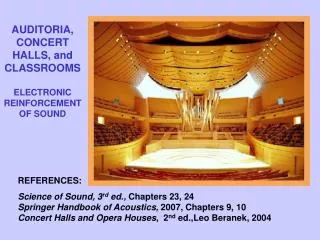
Acoustics and Concert Halls. Stephanie Hsu March 21, 2005. Difficulties of Acoustic Design. Purpose of hall Expense in achieving ideal acoustics Drawings actual hall. Sound Waves. waves: means of transmitting energy from point to point.

E N D
Acoustics and Concert Halls Stephanie Hsu March 21, 2005
Difficulties of Acoustic Design • Purpose of hall • Expense in achieving ideal acoustics • Drawingsactual hall
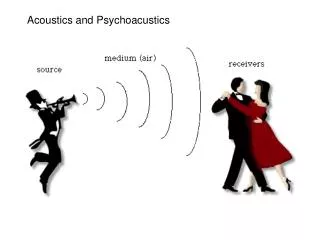
Sound Waves • waves: means of transmitting energy from point to point
Ground provides base for energy to be directly received or transmitted • Flat and hard surfaces
If “perfectly reflecting,” sound will simply keep bouncing back and forth • Perfect reflectors = “Eternal sound” • Low absorption
Loudness vs. Intelligibility • Surfaces around communicator increases efficiency of energy transfer • Goal of acoustic design: achieve balance between • Need to deliver sufficient energy from sourcelistener • Need for good intelligibility
Loudness vs. Intelligibility (cont’d) • Bathrooms • Low absorptioneasy production of high level of sound • Multiple reflections (i.e. reverberation): sufficient overlap of successive sounds blurs out “defects” in sound
W. B. Sabine • Harvard lecture room—too reverberant • Calibrate absorption of cushions, curtains, people, etc. • Measured length of cushion/amount of absorption needed to bring time of reverberation back to original value
Amount of absorption present X Time of reverberation = Constant • Open window: most perfect absorber • o.w.u.s still used as measures of absorption
Desirable Reverberation Rates • Time of reverberation: time taken for energy density of a sound to fall to the level of the threshold of hearing from a given level of sound • (a + x)T = kV • a=amount of absorption in empty room • x=amount of sound added • T=time of reverberation • V=volume of room • k=0.171 (works for rooms of many different shapes and sizes)
Absorbents & Reflectors • ½ dead ½ reverberant room • Absorbent on back wall needed to prevent echoes or “flutter effect”
Methods of Acoustical Design • Small scale model of hall • 1/8 actual size • Recording test sounds (dead enclosure) • Played at 8X normal speed inside model • Resulting sound recorded • Played back at 1/8 speed • Polystyrene foam blocks
Adjustment of Acoustics • Changes in distribution of absorbing and reflecting surfaces • Movable parts of walls or reflectors can be changed to suit different purposes • Electronic modification of acoustic characteristics • Microphones in front, loudspeakers in sides and back • Microphones in space between suspended and structural ceiling