Soil Profile
620 likes | 817 Views
This guide breaks down key components of soil profiles, focusing on genetic horizons, pedons, polypedons, and soil series. Discover the intricacies of soil layers parallel to the surface and their unique characteristics shaped by various soil-forming processes. Learn about different horizons, including O (organic), A (topsoil), E (eluviation), and B (illuviation), and understand essential differences such as leaching and eluviation. A must-read for ecology enthusiasts, students, and professionals interested in soil science and environmental studies.


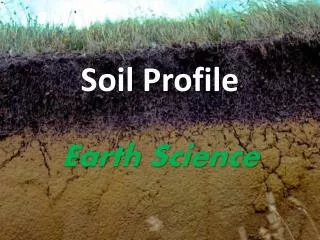
Soil Profile
E N D
Presentation Transcript
Soil genetic horizons -HORIZON: soil layer parallel to surface with characteristics produced by soil-forming processes
3 basic soil units (scale) Pedon: smallest volume called a soil Polypedon: soil body (2 or more pedons) in which soils are relatively uniform Soil Series: groups of like polypedons
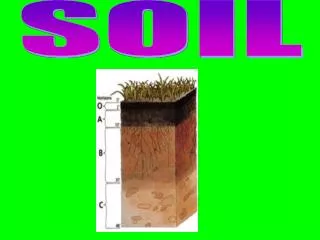
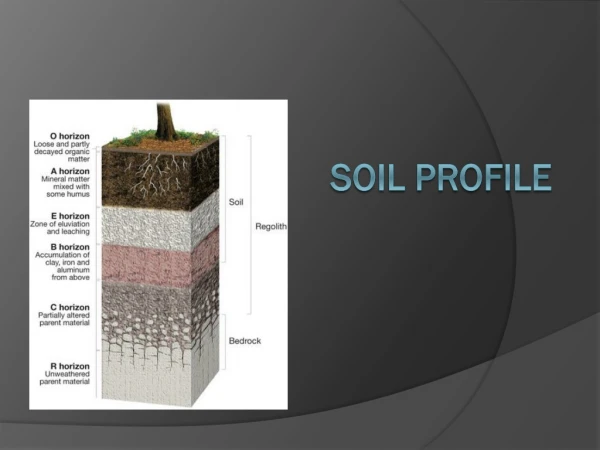
Master horizons O A E B C R Not every soil has all of these!!!
O horizon Organic material Same as litter layer or “duff”
Oi slightly decomposed (litter) : FIBRIC Oe intermediate decomposition: HEMIC Oa highly decomposed : SAPRIC Oi Oe Oa
A horizon (“TOPSOIL”) • topmost mineral horizon accumulation of well-decomposed O.M. • Often bioturbated • surface horizon disturbed by plowing (Ap)
Field trip: • Ap : Agassiz clay, drumlin, prairie
E horizon • LOSS of • silicate clay, Fe & Al oxides, humus by eluviation • carbonates, gypsum by leaching
Leaching vs. eluviation LEACHING: removal of soluble minerals (Ca, Mg, Na) in solution ELUVIATION: loss (by water) of suspended materials (clay, humus, oxides) ”emigrating”
E horizon • lighter color than A • Because the colorful humus and Fe, Al oxides have eluviated away • coarser texture than B • Because the clay eluviated away
B horizon • ACCUMULATED (illuviated ) ”immigration” silicate clay, Fe & Al oxides, carbonates, gypsum, humus • distinguished from A or E: • stronger, redder, or darker color • OR different texture
Bh Has illuviated humus from E (dark, brown or black stain at top of B) Bs Has illuviatedsesquioxides of Fe, Al from E (reddish color at top of B) Bhs Has both
E Bhs
O A E Bh Bs
Bw Bhs E
A E Bhs
A E Bhs Bw
Bt An accumulation of silicate clay in B Can recognize it if you have clay in the B but not as much clay in the A Look at textures for drumlin, prairie, Agassiz clay (soybean field)
Bk Has precipitated carbonates in it; White nodules or streaks Strongly effervescent
w : used if you see a change in B that is not accounted for by other subhorizon letters • Bw If you see changes in color, texture, structure within a B
C horizon • Mineral horizon (not bedrock) underlying A,E,B horizons • not affected by soil-forming processes • may be parent material
C in field trip cores? • If you had only coarse sand and rocks (with no clay or silt) in bottom of cores in drumlin, you may have hit till (C) • Bottom of cores in Agassiz clay may have ben lake clay (C)
R horizon Consolidated rock
Transitional horizons Zone of transition between master horizons AB A B; A dominates BA A B; B dominates AC A C; A dominates EB E B; E dominates etc….
Mixed horizons One horizon scattered within another horizon B/A mixed A&B; B is matrix for A E/B E is matrix etc….
Numbers after letters Changes within master horizon for which there is no subhorizon designation e.g., A1 A2 for color change within A