Understanding Building Function Rules in Practical Scenarios
This guide explores various building function rules through real-life examples, illustrating how to set up and evaluate functions based on specific scenarios. It covers cases such as taxi fees per mile, costs for mowing services, and rental car charges with mileage fees. Each example presents a clear function rule and engages the reader in determining independent and dependent variables, generating ordered pairs, and analyzing whether the relationships are functions. Gain confidence in applying mathematical concepts to everyday situations.

Understanding Building Function Rules in Practical Scenarios
E N D
Presentation Transcript
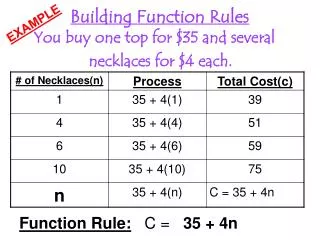
Building Function Rules EXAMPLE You buy one top for $35 and several necklaces for $4 each. Function Rule: C = 35 + 4n
Building Function Rules 1. A taxi company charges a $2.00 fee for a taxi ride and then $.25 per mile. Function Rule: C =
Building Function Rules 2. Convert the minutes to seconds. Function Rule: Y =
Building Function Rules 3. A mowing company charges $25 to mow and an extra $2 per tree trimmed . Make up #’s! Function Rule: B =
Building Function Rules 4. A car rental company charges $85 to rent a car and the $0.50 per mile. Function Rule: Y =
Use #4 to answer the following: 5. What is the independent variable? 6. What is the dependent variable? 7. Write the 4 ordered pairs from your table. 8. Is the relation above a function?
Use #4 to answer the following: 9. If the input is 46, what is the output? 10. Write the input and output above as an ordered pair. 11. If the output is $125, what is the input(miles driven)? 12. Write the input and output above as an ordered pair.