Integrated Gasification Combined Cycle (IGCC) Overview: Pros, Cons, and Comparisons
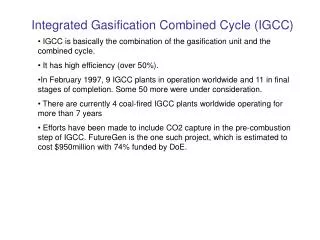
The Integrated Gasification Combined Cycle (IGCC) technology integrates a coal gasifier with a combined cycle plant to produce low-emission energy. It utilizes proven gas turbine technology, offering flexibility to switch between natural gas and coal gas, leading to improved operational efficiency and potential revenue from by-products. While IGCC presents a shorter construction timeline and higher capacity factor, it bears initial costs and risks due to its newer technology. Comparatively, Circulating Fluidized Bed (CFB) systems focus on coal only, presenting unique advantages and limitations.

Integrated Gasification Combined Cycle (IGCC) Overview: Pros, Cons, and Comparisons
E N D
Presentation Transcript
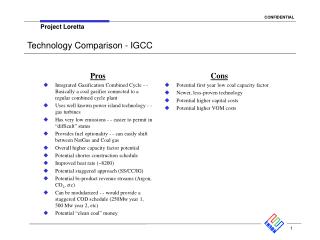
Pros Integrated Gasification Combined Cycle - - Basically a coal gasifier connected to a regular combined cycle plant Uses well known power island technology - - gas turbines Has very low emissions - - easier to permit in “difficult” states Provides fuel optionality - - can easily shift between NatGas and Coal gas Overall higher capacity factor potential Potential shorter construction schedule Improved heat rate (~8200) Potential staggered approach (SS/CC/IG) Potential bi-product revenue streams (Argon, CO2, etc) Can be modularized - - would provide a staggered COD schedule (250Mw year 1, 500 Mw year 2, etc) Potential “clean coal” money Cons Potential first year low coal capacity factor Newer, less-proven technology Potential higher capital costs Potential higher VOM costs Technology Comparison - IGCC
Pros Potential lower capital costs than IGCC Circulating Fluidized Bed Potential lower VOM costs Can use a variety of coals including very low quality “waste coal” - - allows significant coal delivery cost reductions Less complicated technology than IGCC Lower emissions than older technology “pulverized coal” Can be modularized - - installed in blocks of 100Mw - 250Mw Potential “clean coal” money Cons No fuel optionality - - designed for coal only Higher capacity factor while on coal No byproduct revenue streams Potential longer construction schedule Technology Comparison - CFB