Download
1 / 6
60 likes | 167 Views
This report summarizes the outcomes of the Fall Technical Conference focused on dust research and the RA BART Backstop Trading Program. Key discussions included the refinement of SIP templates and technical support documents, as well as applied research reconciling dust transport modeling differences. The Gillette box model was found unreliable, while the ISC model demonstrated reasonable accuracy. Collaboration with WRAP and DOD was emphasized, alongside updates from working groups comprised of states, tribes, and FLMs to develop actionable solutions and regulatory frameworks for addressing air quality issues.

E N D
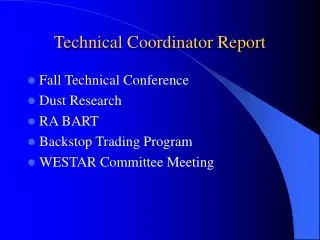
Technical Coordinator Report • Fall Technical Conference • Dust Research • RA BART • Backstop Trading Program • WESTAR Committee Meeting
Fall Technical Conference • On Regional Haze SIPs • Revisit 309 SIP Templates developed in 2000/2001 • Refine SIP temples • Provide focal point for STIP II • Identify key elements of Technical Support Document
Dust Research • Collaboration w/WRAP, DOD • Applied field research to reconcile differences between monitored/modeled dust transport • Findings: • Gillette box model is not reliable • ISC model is reasonably accurate
RA BART Attribution Project • AMC/MTF Initiated • Follow up to RA BART Case Studies • Working Group - States, Tribes, FLMs • Recommend Process and Technical Criteria • Techniques – Monitoring, Source and Observational Modeling applicable to other AQ analysis • MTF/Public Comment
309 Backstop Trading Program • AMC/MTF Initiated • Working Group - States, Tribes, EPA • Update Model Rule/MOU - Develop SIP • To incorporate Supplement to the Annex • To work within State regulatory structures • Address EPA concerns • Review by MTF, AZ Stakeholders, Public
Committee Meeting • Bring together WESTAR Committees • Planning, Technical, Sources, Mobile Sources • Take stock, coordinate cross-committee activities, select co-chairs • Finalize ‘Issue Papers’ • Plan for coming year • Priorities • Actions