Positional and Directional Terms
170 likes | 214 Views
Learn the fundamental anatomical and directional terms in anatomy and physiology. Explore body planes, cavities, organs locations, and divisions to comprehend human body structures better.


Positional and Directional Terms
E N D
Presentation Transcript
DEFINITIONS • Anatomy – the study of the structures of the body (ex.- names of bones) • Physiology – the study of the functions of these structures (ex.- role of bones in the musculoskeletal system)
ANATOMICAL POSITION • ALL descriptions of the body are based on anatomical position. When referring to anatomical position, that means the person is: • Standing • Facing toward you • Arms at their sides • Palms toward you
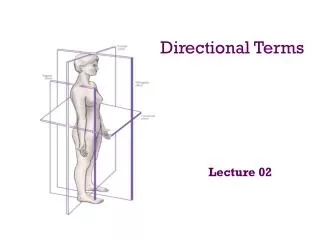
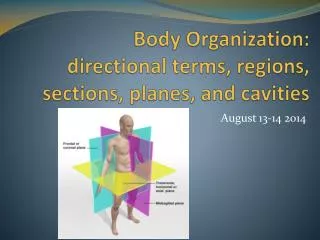
PLANES OF THE BODY • Midsagittal (lateral) – lengthwise plane that divides the body into • equal right and left sides • Sagittal(lateral) – divides the body into unequal right and left sides
PLANES OF THE BODY • Frontal (coronal) - plane that divides the body into front • and back portions • Transverse (horizontal) - plane that divides the body into upper and lower portions
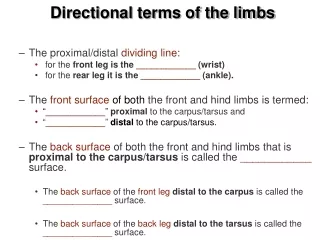
POSITIONAL & DIRECTIONAL TERMSPlease turn to page 22, Table 2.1 • Ventral – front or belly side • Anterior – situated in front • Superior – above, toward the head • Cephalic – toward the head • Proximal – near the midline or beginning of a structure • Medial – toward, near the midline
POSITIONAL & DIRECTIONAL TERMS • Dorsal – back of body or organ • Posterior – situated in back • Inferior – below, toward the feet • Caudal – toward lower part of body • Lateral – away from the midline • Distal – farthest from midline or beginning of a structure
POSITIONAL & DIRECTIONAL TERMS Remember: ALL terms are used in relation to what body part they are being compared to Example: The ankle is () to the knee?
BODY CAVITIES • Spaces within the body that contain and protect internal organs • Dorsal Cavities (back of the body): • Cranial - contains brain, pituitary gland • Spinal - nerves, spinal cord
BODY CAVITIES Ventral Cavities (front of the body): Thoracic - contains heart, lungs, esophagus, trachea, bronchial tubes, thymus, aorta Abdominal - stomach, small & large intestine, spleen, pancreas, liver, gallbladder Pelvic - portion of large & small intestine, rectum, urinary bladder, urethra, ureters, uterus, vagina
LUQ RUQ RLQ LLQ DIVISIONS OF THE ABDOMEN RUQ – right upper quadrant RLQ – right lower quadrant LUQ – left upper quadrant LLQ – left lower quadrant • Abdomin/o/pelv/ic area is divided into four quadrants • Assessment findings, organs, etc… are described by the quadrant they are located in
ORGANS IN THE QUADRANTS OF THE ABDOMINOPELVIC AREA • RUQ - liver, gallbladder, part of pancreas, part of small & large intestine • LUQ - liver, stomach, spleen, part of pancreas, part of small & large intestine
ORGANS IN THE QUADRANTS OF THE ABDOMINOPELVIC AREA • RLQ - part of small and large intestine, right ovary & fallopian tube, right ureter, and appendix • LLQ - part of small and large intestine, left ovary & fallopian tube, left ureter
ABDOMINOPELVIC REGIONS • Named for the PATIENT’s side of body (i.e. his right or left, NOT yours) • Right hypochondriac • Epigastric • Left hypochondriac • Right lumbar • Umbilical • Left lumbar • Right inguinal • Hypogastric • Left inguinal
ABDOMINOPELVIC REGIONS Right Left Hypochondriac Epigastric Hypochondriac Right Left Lumbar Umbilical Lumbar Right Left Inguinal Hypogastric Inguinal
BODY CAVITIES • Divisions of Abdominal cavity • The peritoneum is a membrane surrounding the organs in the abdominal cavity. • The retroperitoneal (retro- = behind) area is behind the peritoneum and contains the kidneys.
Time to Practice!!! • You will be divided into groups. • In your group, create a fictional medical story using the following guidelines: • must use one “plane” of the body • must use four position or directional terms • must contain two ventral cavity organs • must contain one quadrant and one abdominopelvic region Present your story to the class in the form of a skit. You will have 20 minutes to prepare your story & skit. Your story must make sense and contain correct use of the terms.