Exploring the Consumption Effects of Root Beer and Quinine Water: Price and Income Dynamics
This study investigates the price and income effects on the consumption of root beer and quinine water, examining concepts closely tied to economic behavior such as Giffen goods and complement/substitute relationships. Through experiments involving different price points and serving sizes, we analyze how demand shifts in response to income changes and pricing strategies. The findings delve into rational vs. irrational consumer behavior and apply the Slutsky Equation to measure substitution and income effects, offering insights into consumer decision-making processes.

Exploring the Consumption Effects of Root Beer and Quinine Water: Price and Income Dynamics
E N D
Presentation Transcript
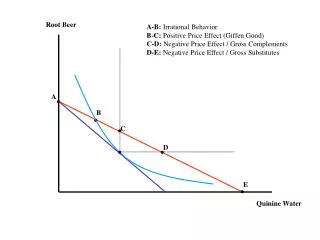
Root Beer A • B • • C D • • E • Quinine Water A-B: Irrational Behavior B-C: Positive Price Effect (Giffen Good) C-D: Negative Price Effect / Gross Complements D-E: Negative Price Effect / Gross Substitutes
Root Beer Quinine Water (a) Initial Experiment (c) Price Experiment (b) Income Experiment
Units of Measure • Price = $ / unit • Presses are rat $ • Serving size per press = units / $ = 1 / Price • .05 cc/press => 20 presses / unit • .1 cc/press => 10 presses / unit • .15 cc/press => 6.7 presses /unit
Negatively Sloped Demand Curve Price Q(P, Income=110) (b) (a) • • (c) • Q(P, Income=60) Consumption
Linear Demand Function Q = 10.1 - 0.63 Price + .03 Income
Positively Sloped Demand Curve Price Q(P, Income=110) (a) (b) • • (c) Q(P, Income=75) • Consumption
Is the Rat Rational? What Does it Mean?
Root Beer Irrational (a) • (c) • • (b) Quinine Water Rational
Is the Rat Rational? How Can We Tell?
Slutsky Equation Price Effect + Income Effect Weighted by Consumption = Substitution Effect Substitution effect must be negative.