An Overview of Oceanography: Understanding Its Subdisciplines and Impact on Humanity
180 likes | 300 Views
Oceanography is the scientific study of the oceans, encompassing various subdisciplines including geological, physical, chemical, and biological oceanography. This field explores how oceans affect our world, with historical examples like Hurricane Katrina and the Indonesia Tsunami demonstrating their impact. From early navigation myths to modern scientific expeditions, oceanographic research has evolved significantly. Notable advancements, including the use of sonar and satellites, continue to enhance our understanding of ocean dynamics and their vital role in Earth's hydrologic cycle.


An Overview of Oceanography: Understanding Its Subdisciplines and Impact on Humanity
E N D
Presentation Transcript
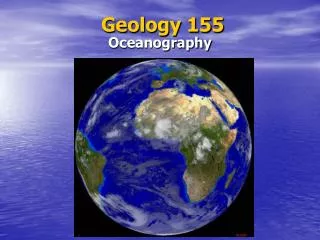
Geology 155 Oceanography
OceanographySubdisciplines • Geological • Physical • Chemical • Biological
How Do the Oceans Impact Us? • Hurricane Katrina • Indonesia Tsunami
2004 Indonesia Tsunami http://asiantsunamisvideos/tsunamiphuket.wmv
Gaining Knowledge of the Oceans • Early Voyages • Science for Voyaging • Age of Discovery • Voyaging for Science
Early Voyages • Early navigation done by keeping constant view of land • Not much knowledge • Thought land was flat • Mostly land and not much water • Mythology was used to explain natural phenomena • Alexander the Great • First marine science library (3rd century BC) • Eratosthenese(230 BC) • Realized Earth was spherical • Looked at different angle of sun’s rays • Celestial navigation (astronomy, mathematics) • Hipparchus (127 BC) • Invented latitude and longitude
Science for Voyaging • Polynesian Colonization • Vikings • Chinese
The Age of Discovery • Prince Henry the Navigator • Christopher Columbus • Ferdinand Magellan
Voyaging for Science • Establish British presence • Charted New Zealand, Australia, Hawaiian Islands • James Cook • Highly accurate charts used as late as WWII • Charles Darwin • Correctly determined how atolls and coral reefs form by volcanic activity HMS Endeavor
Challenger ExpeditionModern Exploration • First Pure Scientific Expedition • Life was possible below 549 m (1800 ft) • Discovered 4,717 new species • Collected ocean water information • Temperature, salinity, and water density • Ocean current and sediment distribution
21st Century Technology Underwater • Sonar • Submersibles Satellite • MODIS • QuikSCAT • TRMM
Ocean Facts • Average depth of the Pacific Ocean = 4,638 m • Average depth of the Atlantic Ocean = 3,872 m • About 70% of Earth’s surface is covered by water • Average temperature = 3.9°C (39.0°F) • Age of oceans = 4 billion years
Hydrologic Cycle • Continuous cycle of how water moves through different reservoirs, or from ocean to air, onto land, to lakes and streams and groundwater back to the sky and ocean.
Hypsographic Curve • Shows distribution of elevations and depths on Earth ( Know how to read graph)