Download
1 / 25
250 likes | 359 Views
Explore the world of biochemistry, from the building blocks of matter to the intricate structures of proteins. Learn about chemical reactions, elements, compounds, bonding, enzymes, water, acids and bases, organic chemistry, and macromolecules. Understand the vital role these concepts play in the complex biochemical processes within the human body.

E N D
Review • Atoms- the building blocks of matter • Nucleus- the center of an atom • Proton-positively charged particle in the nucleus • Neutron-neutral particle in the nucleus of the atom • Electron- negatively charged particle outside the nucleus
More Review • There are many chemical Rxn’s taking place in your body • Chemical reactions are when atoms or groups of atoms reorganize • Bonds are broken and reformed during the process
Ugh… More review • An element is a pure substance that can’t be broken down into another substance • All known elements are located on the periodic table • Isotopes- same number of protons different number of neutrons • May be radioactive • Carbon 12 v. Carbon 14
Still reviewing….. • Compounds- one or more elements combining to form a new substance • Always found in certain ratios (H2O) • Chemically and physically different from the elements it consists of (H or O goes boom) • Can’t be broken into simpler compounds physically • Can be broken down chemically (electrical current and H2O)
You should know this…. • Chemical bonds hold the elements of a compound together • Covalent bond • Shared electrons • STRONG BONDS • Form molecules
Still on bonding….. • Ions & Ionic Bonding • Atoms take or give up electrons • The resulting ion has either a + or – charge • NaCl Na + Cl- • Used to transmit signals in cells • Electrolytes • Held together by electrostatic forces • Disassociate in water
Energy and Rxn’s • Activation Energy- minimum amount of energy for a reaction to take place • A candle won’t burn unless the wick is lit • Flame (energy) provides activation energy
Enzymes • Enzymes are biological catalysts • They lower the activation energy needed for a reaction to proceed • Most reactions in the human body need more energy than 37 0C can provide • Substrate- what the enzyme works on • Active Site- part of the enzyme perfectly matched to the substrate • Like a lock and key
Many things effect enzymes • Temperature- too high/low they don’t work • pH – too high /low they don’t work • Pepsin works best at a pH of 2. Where is it in your body? • What pH do most enzymes work best at? • Denature- the structure of the enzyme is permanently damaged and it will no longer work • Frying an egg
Water • Water is H2O • It is polar • The oxygen has a slight – charge • The hydrogen has a slight + charge
Acids and Bases • Most solutes can dissolve in water • Acids release H+ ions • Bases release OH- ions • Measured on the pH Scale
Organic Chemistry • All Biological elements contain carbon • Organic molecules contain carbon (CO2 is the exception) • Carbon is special: • It can bond with 4 different elements • It can bond with many different carbons • Carbon can form many shapes • Chains, branches, and rings
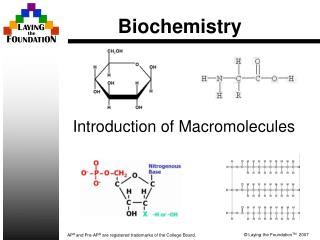
Biochem • Macromolecules- large organic molecules • Polymers- long chains of repeating units called monomers • Held together by covalent bonds • Cellulose, starch, DNA, and proteins are all polymers
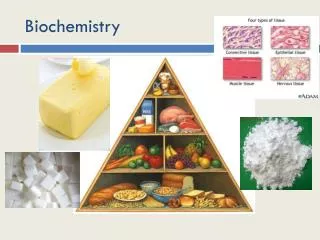
Carbohydrates • Carbohydrates – carbon, hydrogen, and oxygen • Monosaccharide- simple sugars • Glucose • Disaccharide- 2 simple sugars bonded • Sucrose • Polysaccharide-polymers of sugars • Cellulose, starch, glycogen
Lipids • Lipids are mostly made of carbon and hydrogen • Triglyceride-type of lipid • Liquid in plants (oil) • Solid in animals (butter)
Saturated vs. Unsaturated Fats • Saturated • Can not bind to any more H • Solid • Unsaturated • Have a double bond and a kink • liquid
Phospholipids • Amphipathic- • Have a polar head • Non-polar tail • Component of cell membranes • Biological Barriers
Steroids • Cholesterol- makes cell membranes leaky • Estrogen- • Testostone-
Structure of Proteins • Proteins are polymers of amino acid • Proteins are made of Carbon, hydrogen, oxygen, nitrogen and sometime sulfur
Amino Acids • There are only 20 amino acids • All proteins are made out of different combinations of amino acids • Amino acids covalently bond to each other
Protein Structure • Amino acids fold into a 3-D shape • α-helix • β-pleated sheet • 3-D shape held together by hydrogen bonding • If the shape changes the protein does not function