Understanding the Types of Pronouns: A Comprehensive Guide
Explore the various types of pronouns, including personal, possessive, reflexive, and more. Learn how to use personal pronouns such as I, you, and they, along with possessive pronouns like my and hers. Discover reflexive pronouns for self-reference, relative pronouns to introduce clauses, and interrogative pronouns for questioning. Additionally, we cover demonstrative and indefinite pronouns with examples to aid understanding. Improve your grammar skills and enhance your writing by mastering the use of pronouns in everyday language.

Understanding the Types of Pronouns: A Comprehensive Guide
E N D
Presentation Transcript
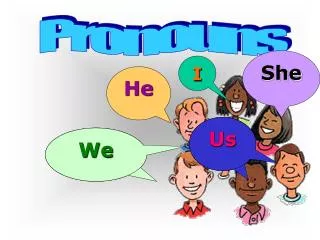
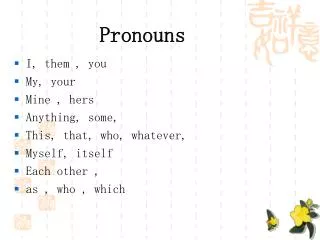
There are several types of Pronouns Personal Pronouns: I, me You He, him She, her It We, us They, them
Examples: Mrs. Carney likes to read. I like to read. English 9 students would like this book. Youwould like this book. Sally ate her dinner. She ate her dinner.
I enjoyed that book. I enjoyed it. Mrs. Carney and our class will read this book. We will read this book.
Possessive Pronouns: To show ownership. Sally’s cat ran away. Her cat ran away.
Possessive Pronouns My, mine Your, yours His Her, hers Its Our, ours Their, theirs
Examples: Her coat. My soccer ball. This car is mine. A note about its vs. it’s: My car got its bright color back after I washed it. It’s cold outside. (NOT the pronoun form)!
Reflexive and Intensive Pronouns Myself Yourself Himself, herself, itself Ourselves Yourselves Themselves
Usage: You can use them reflexively: Miranda explained herself. You can use them intensively for emphasis: Miranda herself made the explanation.
Relative Pronoun Who Whom Which That Whose These words introduce subordinate clauses.
Examples: The college that I chose is in Texas. Do you know the woman whose writing was mentioned? Mr. Lopez is a counselor who never betrays me.
Interrogative Pronouns Who Whom Which Whose What Ask a question -
Examples Who borrowed my pen? Which color do you prefer?
Demonstrative Pronouns Used to point out persons or things: This These That Those
Examples This is the correct answer. That is a great book.
Note: Sometimes these words can also be adjectives. That is my favorite book. That book is my favorite.
“That” can also be a conjunction • He said that we were late. • We are certain that this is true. • “That” in these cases is not acting like a pronoun.
Indefinite Pronouns Most Commonly Used Indefinite Pronouns: All everybody no one Another everyone one Any few other Anybody many several Anyone most some Both neither somebody Each nobody someone Either none such
Examples: Most of the members have voted. Everyone favors a weekly meeting. None of the members wanted weekend meetings.