Understanding Probability and Conditional Events in Statistics
290 likes | 407 Views
This review focuses on the concepts of probability, focusing on Bayes' theorem, union and intersection of events, and decision analysis through tree diagrams. Key examples include the probability of airport security alerts and the pathways of high school athletes transitioning to professional sports. Understanding the conditional probability and applying the multiplication and addition rules are essential for solving complex problems. Prepare for the cumulative test on chapters 6 and 7, ensuring a solid grasp of probability concepts.


Understanding Probability and Conditional Events in Statistics
E N D
Presentation Transcript
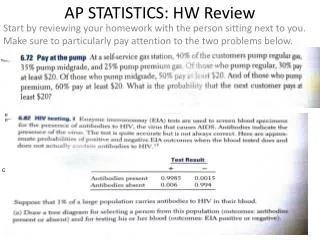
AP STATISTICS: HW Review Start by reviewing your homework with the person sitting next to you. Make sure to particularly pay attention to the two problems below.
More Bayes: BAGS SCREENED BAGS are screened at the PROVIDENCE airport. 78% of bags that contain a weapon will trigger an alarm. 14% of bags that do not contain a weapon will also trigger the alarm. If 1 out of every 1200 bags contains a weapon than what is the probability that a bag that triggers an alarm actually contains a weapon?
Chapter Review Tomorrow • Chapter 6 and 7 cumulative test next Thursday.
Union • Recall: the union of two or more events is the event that at least one of those events occurs.
Union Addition Rule for the Union of Two Events: • P(A or B) = P(A) + P(B) – P(A and B)
Intersection • The intersection of two or more events is the event that all of those events occur.
The General Multiplication Rule for the Intersection of Two Events • P(A and B) = P(A) ∙ P(B/A) • is the conditional probability that event B occurs given that event A has already occurred.
Extending the multiplication rule Make sure to condition each event on the occurrence of all of the preceding events. • Example: The intersection of three events A, B, and C has the probability: • P(A and B and C) = P(A) ∙ P(B/A) ∙ P(C/(A and B))
Example:The Future of High School Athletes • Five percent of male H.S. athletes play in college. • Of these, 1.7% enter the pro’s, and • Only 40% of those last more than 3 years.
Define the events: • A = {competes in college} • B = {competes professionally} • C = {In the pros’s 3+ years}
Find the probability that the athlete will compete in college and then have a Pro career of 3+ years. P(A) = .05, P(B/A) = .017, P(C/(A and B)) = .40 P(A and B and C) • = P(A)P(B/A)P(C/(A and B)) • = 0.05 ∙ 0.017 ∙ 0.40 • = 0.00034
Interpret: 0.00034 • 3 out of every 10,000 H.S. athletes will play in college and have a 3+ year professional life!
Tree Diagrams • Good for problems with several stages.
Example: A future in Professional Sports? • What is the probability that a male high school athlete will go on to professional sports? • We want to find P(B) = competes professionally. • Use the tree diagram provided to organize your thinking. (We are given P(B/Ac = 0.0001)
The probability of reaching B through college is: P(B and A) = P(A) P(B/A) = 0.05 ∙ 0.017 = 0.00085 (multiply along the branches)
The probability of reaching B with out college is: P(B and AC) = P(AC ) P(B/ AC ) = 0.95 ∙ 0.0001 = 0.000095
Use the addition rule to find P(B) P(B) = 0.00085 + 0.000095 = 0.000945 About 9 out of every 10,000 athletes will play professional sports.
Example: Who Visits YouTube? What percent of all adult Internet users visit video-sharing sites? P(video yes ∩ 18 to 29) = 0.27 • 0.7 =0.1890 P(video yes ∩ 30 to 49) = 0.45 • 0.51 =0.2295 P(video yes ∩ 50 +) = 0.28 • 0.26 =0.0728 P(video yes) = 0.1890 + 0.2295 + 0.0728 = 0.4913
Independent Events • Two events A and B that both have positive probabilities are independentif P(B/A) = P(B)
Decision Analysis • One kind of decision making in the presence of uncertainty seeks to make the probability of a favorable outcome as large as possible.
Example : Transplant or Dialysis • Lynn has end-stage kidney disease: her kidneys have failed so that she can not survive unaided. • Her doctor gives her many options but it is too much to sort through with out a tree diagram. • Most of the percentages Lynn’s doctor gives her are conditional probabilities.
Transplant or Dialysis • Each path through the tree represents a possible outcome of Lynn’s case. • The probability written besides each branch is the conditional probability of the next step given that Lynn has reached this point.
For example: 0.82 is the conditional probability that a patient whose transplant succeeds survives 3 years with the transplant still functioning. • The multiplication rule says that the probability of reaching the end of any path is the product of all the probabilities along the path.
What is the probability that a transplant succeeds and endures 3 years? • P(succeeds and lasts 3 years) = P(succeeds)P(lasts 3 years/succeeds) = (0.96)(0.82) = 0.787
What is the probability Lyn will survive for 3 years if she has a transplant? Use the addition rule and highlight surviving on the tree. • P(survive) = P(A) + P(B) + P(C) = 0.787 + 0.054 + 0.016 = 0.857
Her decision is easy: • 0.857 is much higher than the probability 0.52 of surviving 3 years on dialysis.
Homework • 6.3 Review Exercises: 6.85, 6.88, 6.90, 6.93