Introduction to Compiler Design: Principles and Practical Applications
This course provides an in-depth exploration of compiler design, focusing on the fundamental principles and techniques used in modern compilers and interpreters. Students will learn the key differences between compilers and interpreters, covering various programming languages, including imperative, object-oriented, functional, and logic programming languages. The curriculum includes a hands-on project to translate a Java subset into X86, along with a theoretical final exam. By the end, students will grasp essential concepts like lexical analysis, syntax parsing, and code generation.

Introduction to Compiler Design: Principles and Practical Applications
E N D
Presentation Transcript
Course Overview Mooly Sagiv msagiv@tau.ac.il TA: Roman Manevich rumster@tau.ac.il http://www.cs.tau.ac.il/~msagiv/courses/wcc08.html TA: http://www.cs.tau.ac.il/~rumster/wcc07/ Textbook: Modern Compiler Design Grune, Bal, Jacobs, Langendoen CS0368-3133-01@listserv.tau.ac.il
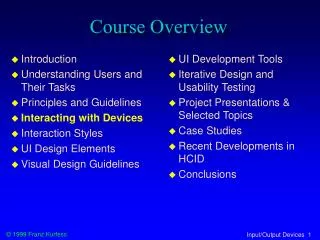
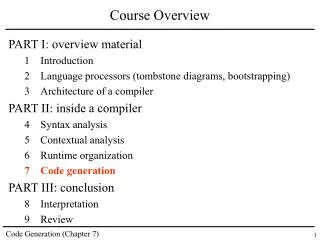
Outline • Course Requirements • High Level Programming Languages • Interpreters vs. Compilers • Why study compilers (1.1) • A simple traditional modern compiler/interpreter (1.2) • Subjects Covered • Summary
Course Requirements • Compiler Project 50% • Translate Java Subset into X86 • Final exam 45% (must pass) • Theoretical Exercise 5%
Lecture Goals • Understand the basic structure of a compiler • Compiler vs. Interpreter • Techniques used in compilers
High Level Programming Languages • Imperative • Algol, PL1, Fortran, Pascal, Ada, Modula, and C • Closely related to “von Neumann” Computers • Object-oriented • Simula, Smalltalk, Modula3, C++,Java, C# • Data abstraction and ‘evolutionary’form of program development • ClassAn implementation of an abstract data type (data+code) • Objects Instances of a class • Fields Data (structure fields) • MethodsCode (procedures/functions with overloading) • InheritanceRefining the functionality of a class with different fields and methods • Functional • Lisp, Scheme, ML, Miranda, Hope, Haskel, OCaml, F# • Logic Programming • Prolog
Other Languages • Hardware description languages • VHDL • The program describes Hardware components • The compiler generates hardware layouts • Shell-languages Shell, C-shell, REXX • Include primitives constructs from the current software environment • Graphics and Text processing TeX, LaTeX, postscript • The compiler generates page layouts • Web/Internet • HTML, MAWL, Telescript, JAVA • Intermediate-languages • P-Code, Java bytecode, IDL, CLR
source-program program’s output program’s input Interpreter • Input • A program • An input for the program • Output • The required output interpreter
int x; scanf(“%d”, &x); x = x + 1 ; printf(“%d”, x); 5 6 Example C interpreter
source-program program’s output object-program program’s input Compiler • Input • A program • Output • An object program that reads the input and writes the output compiler
int x; scanf(“%d”, &x); x = x + 1 ; printf(“%d”, x); 6 5 Example Sparc-cc-compiler add %fp,-8, %l1 mov %l1, %o1 call scanf ld [%fp-8],%l0 add %l0,1,%l0 st %l0,[%fp-8] ld [%fp-8], %l1 mov %l1, %o1 call printf assembler/linker object-program
Remarks • Both compilers and interpreters are programs written in high level languages • Requires additional step to compile the compiler/interpreter • Compilers and interpreters share functionality
Executable compiler Output Executable program exe Y exe = Program source txt L2 = X Input Bootstrapping a compiler L2 Compiler source txt L1 L1 Compiler L2 Compiler Program
Conceptual structure of acompiler Executable code Source text txt exe Frontend (analysis) Semantic Representation Backend (synthesis) Compiler
X Input Conceptual structure of aninterpreter Output Source text txt Y interpretation Frontend (analysis) Semantic Representation
Conceptually simpler (the definition of the programming language) Easier to port Can provide more specific error report Normally faster [More secure] Can report errors before input is given More efficient Compilation is done once for all the inputs --- many computations can be performed at compile-time Sometimes evencompile-time + execution-time < interpretation-time Interpreter vs. Compiler
Interpreters provide specific error report scanf(“%d”, &y); if (y < 0) x = 5; ... if (y <= 0) z = x + 1; • Input-program • Input data y=0
Compilers can provide errors beforeactual input is given scanf(“%”, &y); if (y < 0) x = 5; ... if (y <= 0) /* line 88 */ z = x + 1; • Input-program • Compiler-Output “line 88: x may be used before set''
Compilers can provide errors beforeactual input is given int a[100], x, y ; scanf(“%d”, &y) ; if (y < 0) /* line 4*/ y = a ; • Input-program • Compiler-Output“line 4: improper pointer/integer combination: op =''
scanf(“%d”, &x); y = 5 ; z = 7 ; x = x +y*z; printf(“%d”, x); Compilers are usually more efficient Sparc-cc-compiler add %fp,-8, %l1 mov %l1, %o1 call scanf mov 5, %l0st %l0,[%fp-12] mov 7,%l0 st %l0,[%fp-16] ld [%fp-8], %l0 ld [%fp-8],%l0 add %l0, 35 ,%l0 st %l0,[%fp-8] ld [%fp-8], %l1 mov %l1, %o1 call printf
Machine Interpreter Compiler vs. Interpreter Source Code Executable Code preprocessing processing Source Code Intermediate Code processing preprocessing
Why Study Compilers? • Become a compiler writer • New programming languages • New machines • New compilation modes: “just-in-time” • Using some of the techniques in other contexts • Design a very big software program using a reasonable effort • Learn applications of many CS results (formal languages, decidability, graph algorithms, dynamic programming, ... • Better understating of programming languages and machine architectures • Become a better programmer
Why study compilers? • Compiler construction is successful • Proper structure of the problem • Judicious use of formalisms • Wider application • Many conversions can be viewed as compilation • Useful algorithms
C++ C++ Pentium Pentium Java Java MIPS MIPS C C Sparc Sparc Pascal Pascal ML ML Proper Problem Structure • Simplify the compilation phase • Portability of the compiler frontend • Reusability of the compiler backend • Professional compilers are integrated IR
Judicious use of formalisms • Regular expressions (lexical analysis) • Context-free grammars (syntactic analysis) • Attribute grammars (context analysis) • Code generator generators (dynamic programming) • But some nitty-gritty programming
regular expressions scanner input program tokens Use of program-generating tools • Parts of the compiler are automatically generated from specification Jlex
specification code Use of program-generating tools • Simpler compiler construction • Less error prone • More flexible • Use of pre-canned tailored code • Use of dirty program tricks • Reuse of specification tool output input
Wide applicability • Structured data can be expressed using context free grammars • HTML files • Postscript • Tex/dvi files • …
Generally useful algorithms • Parser generators • Garbage collection • Dynamic programming • Graph coloring
A simple traditional modular compiler/interpreter (1.2) • Trivial programming language • Stack machine • Compiler/interpreter written in C • Demonstrate the basic steps
The abstract syntax tree (AST) • Intermediate program representation • Defines a tree - Preserves program hierarchy • Generated by the parser • Keywords and punctuation symbols are not stored (Not relevant once the tree exists)
Syntax tree expression ‘*’ expression number ‘5’ ‘(’ expression ‘)’ identifier ‘+’ identifier ‘a’ ‘b’
Abstract Syntax tree ‘*’ ‘5’ ‘+’ ‘a’ ‘b’
Annotated Abstract Syntax tree type:real loc: reg1 ‘*’ type:real loc: reg2 type:integer ‘5’ ‘+’ type:real loc: sp+8 ‘a’ ‘b’ type:real loc: sp+24
Structure of a demo compiler/interpreter Lexical analysis Code generation Intermediate code (AST) Syntax analysis Context analysis Interpretation
Input language • Fully parameterized expressions • Arguments can be a single digit expression digit | ‘(‘ expression operator expression ‘)’ operator ‘+’ | ‘*’ digit ‘0’ | ‘1’ | ‘2’ | ‘3’ | ‘4’ | ‘5’ | ‘6’ | ‘7’ | ‘8’ | ‘9’
Driver for the demo compiler #include "parser.h" /* for type AST_node */ #include "backend.h" /* for Process() */ #include "error.h" /* for Error() */ int main(void) { AST_node *icode; if (!Parse_program(&icode)) Error("No top-level expression"); Process(icode); return 0; }
Lexical Analysis • Partitions the inputs into tokens • DIGIT • EOF • ‘*’ • ‘+’ • ‘(‘ • ‘)’ • Each token has its representation • Ignores whitespaces
Header file lex.h for lexical analysis /* Define class constants */ /* Values 0-255 are reserved for ASCII characters */ #define EoF 256 #define DIGIT 257 typedef struct {int class; char repr;} Token_type; extern Token_type Token; extern void get_next_token(void);
#include "lex.h" static int Layout_char(int ch) { switch (ch) { case ' ': case '\t': case '\n': return 1; default: return 0; } } token_type Token; void get_next_token(void) { int ch; do { ch = getchar(); if (ch < 0) { Token.class = EoF; Token.repr = '#'; return; } } while (Layout_char(ch)); if ('0' <= ch && ch <= '9') {Token.class = DIGIT;} else {Token.class = ch;} Token.repr = ch; }
Parser • Invokes lexical analyzer • Reports syntax errors • Constructs AST
Parser Environment #include "lex.h" #include "error.h" #include "parser.h" static Expression *new_expression(void) { return (Expression *)malloc(sizeof (Expression)); } static void free_expression(Expression *expr) {free((void *)expr);} static int Parse_operator(Operator *oper_p); static int Parse_expression(Expression **expr_p); int Parse_program(AST_node **icode_p) { Expression *expr; get_next_token(); /* start the lexical analyzer */ if (Parse_expression(&expr)) { if (Token.class != EoF) { Error("Garbage after end of program"); } *icode_p = expr; return 1; } return 0; }
Parser Header File typedef int Operator; typedef struct _expression { char type; /* 'D' or 'P' */ int value; /* for 'D' */ struct _expression *left, *right; /* for 'P' */ Operator oper; /* for 'P' */ } Expression; typedef Expression AST_node; /* the top node is an Expression */ extern int Parse_program(AST_node **);
P P P * + * D D D D 4 9 3 2 AST for (2 * ((3*4)+9)) type right left oper
Parse_Operator static int Parse_operator(Operator *oper) { if (Token.class == '+') { *oper = '+'; get_next_token(); return 1; } if (Token.class == '*') { *oper = '*'; get_next_token(); return 1; } return 0; }
Parsing Expressions • Try every alternative production • For P A1 A2 … An | B1 B2 … Bm • If A1 succeeds • If A2 succeeds • if A3 succeeds • ... • If B1 succeeds • If B2 succeeds • ... • No backtracking • Recursive descent parsing • Can be applied for certain grammars • Generalization: LL1 parsing
static int Parse_expression(Expression **expr_p) { Expression *expr = *expr_p = new_expression(); if (Token.class == DIGIT) { expr->type = 'D'; expr->value = Token.repr - '0'; get_next_token(); return 1; } if (Token.class == '(') { expr->type = 'P'; get_next_token(); if (!Parse_expression(&expr->left)) { Error("Missing expression"); } if (!Parse_operator(&expr->oper)) { Error("Missing operator"); } if (!Parse_expression(&expr->right)) { Error("Missing expression"); } if (Token.class != ')') { Error("Missing )"); } get_next_token(); return 1; } /* failed on both attempts */ free_expression(expr); return 0; }
P P P * + * D D D D 4 9 3 2 AST for (2 * ((3*4)+9)) type right left oper
Context handling • Trivial in our case • No identifiers • A single type for all expressions
Code generation • Stack based machine • Four instructions • PUSH n • ADD • MULT • PRINT
Code generation #include "parser.h" #include "backend.h" static void Code_gen_expression(Expression *expr) { switch (expr->type) { case 'D': printf("PUSH %d\n", expr->value); break; case 'P': Code_gen_expression(expr->left); Code_gen_expression(expr->right); switch (expr->oper) { case '+': printf("ADD\n"); break; case '*': printf("MULT\n"); break; } break; } } void Process(AST_node *icode) { Code_gen_expression(icode); printf("PRINT\n"); }