Object-Oriented and Classical Software Engineering Overview
This course provides an in-depth look into both object-oriented and classical software engineering practices, as outlined in the sixth edition of Schach's textbook. It covers key aspects of software engineering, including the software life cycle, testing methodologies, team dynamics, and essential tools. The course is structured into two parts, focusing on foundational concepts and workflows throughout various stages of software development. Students will gain insights into requirements gathering, analysis, design, implementation, and post-delivery maintenance, along with advanced UML concepts.

Object-Oriented and Classical Software Engineering Overview
E N D
Presentation Transcript
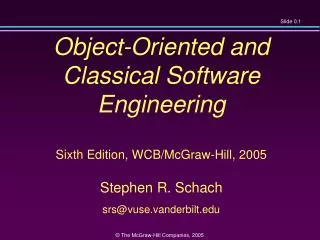
Object-Oriented and Classical Software EngineeringSixth Edition, WCB/McGraw-Hill, 2005Stephen R. Schachsrs@vuse.vanderbilt.edu
Course Overview • Part 1. Introduction to Software Engineering 1. The Scope of Software Engineering 2. Software Life-Cycle Models 3. The Software Process 4. Teams 5. The Tools of the Trade 6. Testing 7. From Modules to Objects 8. Reusability and Portability 9. Planning and Estimating
Course Overview • Part 2. The Workflows of the Software Life Cycle 10. Requirements 11. Classical Analysis 12. Object-Oriented Analysis 13. Design 14. Implementation 15. Postdelivery Maintenance 16. More on UML