SlideServe
Menu
Preferences
© SlideServe · v2026

Understanding Strong Acids and Bases: Definitions and Strength Factors

bernie avatar
13 slides · 320 Views · 130 likes · Aug 24, 2014

This quiz covers key concepts related to strong acids and bases, including their definitions and properties. It identifies the six strong acids and bases, along with the conjugate acids and bases of compounds such as bicarbonate and ammonia. The material also explains the definitions of Lewis bases, Brønsted-Lowry acids, and Arrhenius acids and explores factors influencing acid strength, including polarity and bond strength. Additionally, it predicts reaction directions based on acid and base strengths.
Understanding Strong Acids and Bases: Definitions and Strength Factors - slide 1
01 / 13Understanding Strong Acids and Bases: Definitions and Strength Factors
1 / 17

Download Presentation

Understanding Strong Acids and Bases: Definitions and Strength Factors
An Image/Link below is provided (as is) to download presentation

Download Policy: Content on the Website is provided to you AS IS for your information and personal use and may not be sold / licensed / shared on other websites without getting consent from its author.Content is provided to you AS IS for your information and personal use only. Download presentation by click this link. While downloading, if for some reason you are not able to download a presentation, the publisher may have deleted the file from their server.During download, if you can't get a presentation, the file might be deleted by the publisher.

E N D

More Related Content

Presentation Transcript
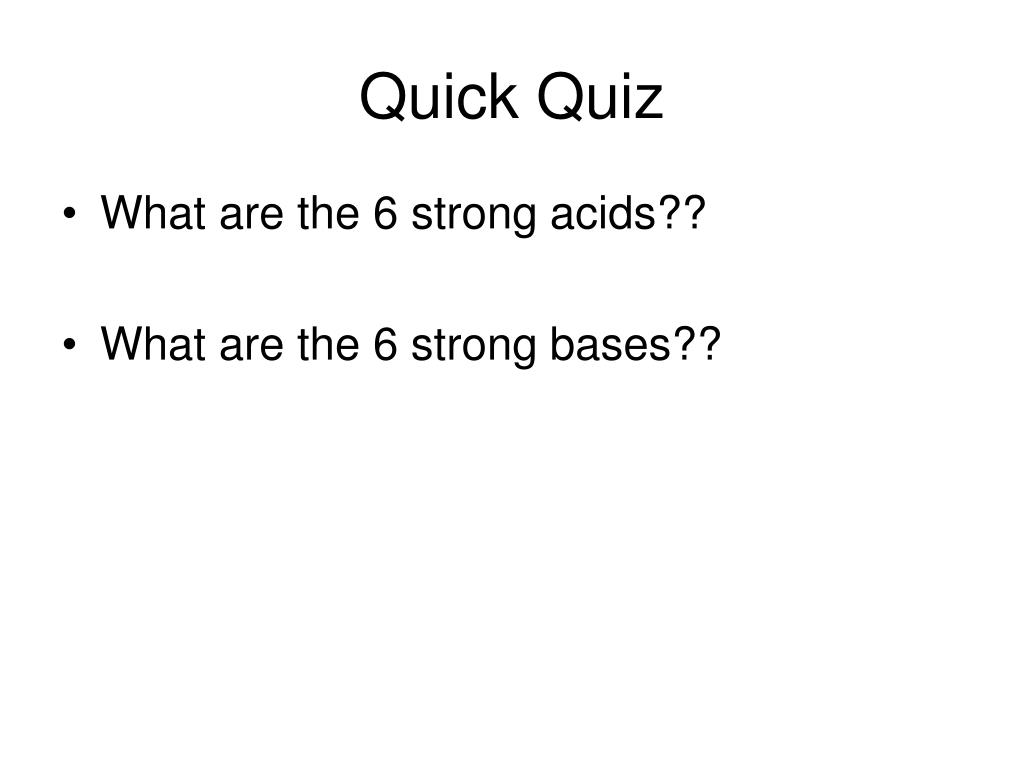
  1. Quick Quiz • What are the 6 strong acids?? • What are the 6 strong bases??

  2. Give the conjugate acids of the following: • HCO3- • NH3 • OH- • SO4-2

  3. Give the conjugate bases of the following: • HCO3- • NH3 • HSO4- • H3PO4 • H2O

  4. Define • A Lewis Base • A Bronsted Lowry acid • An Arrhenius Acid

  5. 15.4 Relative Strengths (659) • Table 15.2 p660 compares relative strengths of acids and bases. • A reaction normally goes in the direction of the weaker acid & base. • The strongest acids have the weakest conjugate bases and vice versa.

  6. Predict the direction of the reaction based on the Table 15.2: (661) • SO4-2 + HCN  HSO4- + CN- • H2S + C2H3O2- HC2H3O2 + HS-

  7. 15.5 Factors affecting acid strength (662):

  8. Polarity • The more polar bonds allow protons to be removed easier increasing the acid strength. • Across a period electronegatives increase, increasing the polarity and acid strength. • H2O<HF

  9. Bond strength • The larger the atom is which H is bonded to, the weaker the bond and thus a stronger acid. • Down a family the radius increases, decreasing the bond strength and increasing the acid strength. • HF<HCl<HBr<HI

  10. Oxoacids: H – O – Y • For a series of oxoacids of the same structure, differing only in the atom Y, the acid strength increases with the electronegativity of Y. • HIO<HBrO<HClO

  11. Multiple oxygen atoms • For a series of oxoacids, (HO)mYOn, the acid strength increases with n. The more O’s the stronger the acid. • HClO< HClO2< HClO3< HClO4

  12. Polyprotic Acids • Strength decreases as protons are lost. • HPO4-2 < H2PO4- < H3PO4

  13. HOMEWORK – OK KT? Read 15.4 - 5 p.676 Q 35- 42 odds