Modeling the Axon
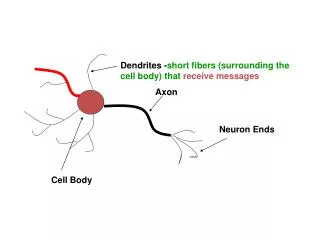
This work explores the essential role of myelination in neuronal function, highlighting its biological significance in ion movement and action potentials. By modeling neurons using circuit theory, we can analyze the behavior of ions, electrical currents, and capacitance in axons. Key circuit laws, including Kirchhoff's laws, are used to derive differential equations that govern neuronal activity. The findings underline how myelination decreases capacitance and enhances conduction velocity, enabling the effective transmission of action potentials along the axon.

Modeling the Axon
E N D
Presentation Transcript
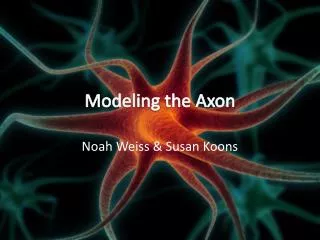
Modeling the Axon Noah Weiss & Susan Koons
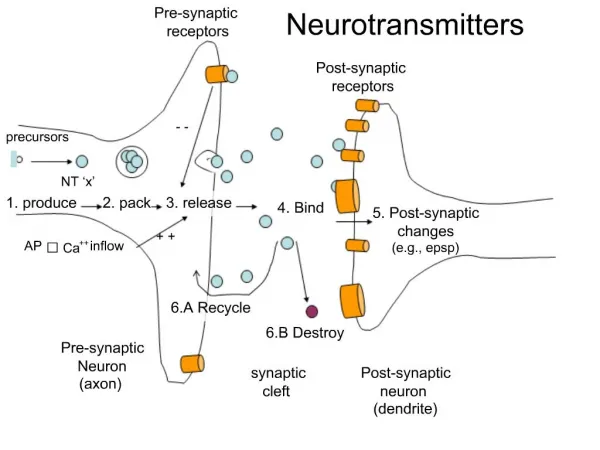
Ion Movement Neuroscience: 3ed
Biological Significance of Myelination Neuroscience: 3ed
Biological Significance of Myelination Neuroscience: 3ed
Biological Significance of Myelination Neuroscience: 3ed
Circuit Notation • Resistors: Linear or non-linear F(V,I)=0 V=IR I=f(V) V = h(I) • Capacitors: • Pumps:
Circuit Laws • Kirchhoff’s Current Law: The principle of conservation of electric charge implies that: The sum of currents flowing towards a point is equal to the sum of currents flowing away from that point. i2 i3 i1 i1 = i2 + i3
Circuit Laws • Kirchhoff’s Voltage Law The directed sum of the electrical potential differences around any closed circuit must be zero. (Conservation of Energy) VR1 + VR2 + VR3 + VC =0 R2 R3 R1
Circuit Model • Neurons can be modeled with a circuit model • Each circuit element has an IV characteristic • The IV characteristics lead to differential equation(s) • Use Kirchhoff’s laws and IV characteristics to get the differential equations
Equations- Circuit Model • Solve for and use • To find use the current law: • Additionally, define the absolute current • Assume a linear resistor with (small) resistance γ in series with the pumps • Use Kirchhoff’s laws to get:
Reducing Dimensions • Assume the “N” curve doesn’t interact with the “S” curve • All three parts of “N” are within primary branch of “S” • Also, let ε = 0: I V K Na
Reducing Dimensions • Substitute the 4th equation into the 1st • Nullclines: Set the derivatives equal to zero • Nontrivial nullcline in the 2nd and 3rd equations are same • Re-arrange and obtain the following:
Resting Potential • Let • Analyze the nullclines: vector field directions • Assume C<<1: singular perturbation • nullcline intersects nullcline in primary branch IA IA nullcline VC nullcline Vc
Action Potential Conditions • Increase to shift the nullcline upward • To get an action potential:
Action Potential Conditions • The “N” curve has 2 “knee” points at • The “S” curve is merely linear by assumption (i.e. is constant) • Some algebra shows that must satisfy: >=
Multiple Nodes Inside the cell Outside the cell
Multiple Nodes • Recall the equations for one node: • There is no outgoing current • Consider a second node that is not coupled to the first node • It should have the same equation (but with different currents)
Multiple Nodes • Couple the nodes by adding a linear resistor between them Current between the nodes
The General Case (N nodes) • This is the general equation for the nth node • In and out currents are derived in a similar manner:
Results C=.1 pF Forcing current
Results C=.1 pF
Results C=.1 pF
Results C=.1 pF
Results C=.01 pF
Results C=.01 pF
Results C=.7 pF
Results C=.7 pF
Transmission Failure (x10 pF)
Transmission Failure (ms) (x10 pF)
The Importance of Myelination (x100 mV) (ms)
The Importance of Myelination The Importance of Myelination- Myelinated Axon (x100 mV) (ms)
Conclusions • Myelination matters! Myelination decreases capacitance and increases conductance velocity • If capacitance is too high, the pulse will not transmit • First model that shows a pulse that travels down the entire axon without dying out