Understanding Population Dynamics: Methods and Influences on Size and Density
50 likes | 178 Views
Chapter 21.2 explores the study of populations, focusing on methods to determine population size such as direct observation, indirect signs, sampling, and the mark-recapture technique. It discusses factors that influence population changes, including birth and death rates, immigration, and emigration. The concept of population density is defined alongside its formula for calculation. Additionally, limiting factors like food, water, space, and weather are examined, along with the carrying capacity— the maximum population an area can sustain.


Understanding Population Dynamics: Methods and Influences on Size and Density
E N D
Presentation Transcript
Determining Population Size • Direct Observation • count all the members • Indirect Observation • observe signs (nests) • Sampling • measure a small area and then multiply to find the number in a larger area • Mark and Recapture
Changes in Population Size • Births and Deaths • If the birth rate is higher than the death rate than the population size will increase • If the death rate is higher than the birth rate the population size will decrease • Immigration (moving into an area) • Emigration (moving out of an area)
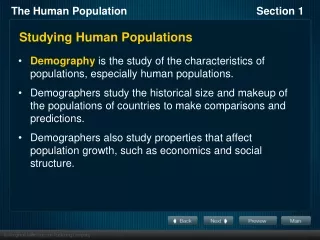
Population Density • Definition – the number of individuals in an area of specific size • Formula – Number of individuals / unit area Ex: 20 butterflies / 10 m2 = 2 butterflies/m2
Limiting Factors • Definition: An environmental Factor that causes a population to decrease • Food and Water • Space • Weather • Carrying capacity – the largest population size an area can hold