Detailed Mechanism of Bromination Reaction in Alkanes
160 likes | 294 Views
This document outlines the stepwise reaction mechanism for the bromination of C5H12 through radical interactions with Br2 under UV light. It details the gradual formation of C5H11Br and HBr, emphasizing the rate-determining step and the role of activation energy (Ea) using the Arrhenius equation. The kinetics are analyzed, demonstrating how temperature and molecular collisions influence reaction rates. The study also includes the concept of the activated complex, transition states, and how catalysts can affect the overall reaction kinetics.


Detailed Mechanism of Bromination Reaction in Alkanes
E N D
Presentation Transcript
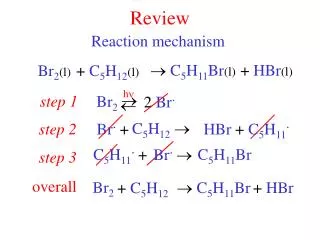
Review Reaction mechanism C5H11Br(l) + HBr(l) Br2(l) + C5H12(l) h 2 Br. step 1 Br2 C5H12 step 2 Br. + HBr + C5H11. C5H11. + Br. C5H11Br step 3 overall Br2 C5H11Br + HBr + C5H12
Br2(l) + C5H12(l) C5H11Br(l) + HBr(l) h 2 Br. step 1 Br2 C5H12 step 2 Br. + HBr + C5H11. step 3 C5H11. + Br. C5H11Br assumestep 2 is rate determining (slow) rate = k2 [Br.] [C5H12] Br.= intermediate [Br.]2 [Br2] Keq = rate = k2 k’[Br2]1/2 [C5H12] rate = k’[Br2]1/2 [C5H12] [Br.] = Keq1/2 [Br2]1/2 11/2 order reaction
bimolecular elementary steps increase [react] increase rate of reaction increase T increase rate of reaction increase number of collisions increase force of collisions
T2 Ea T1 T2 > T1 # molecules Kinetic Energy minimum energy required for reaction: activation energy = Ea
Arrhenius Equation T dependence of a rate constant, k k = z p e-Ea/RT k a) increases b) decreases with T with Ea k a) decreases b) increases Ea = activation energy (kJ/mol) R = gas constant (8.314 x 10⁻³kJ/K mol) T = temperature (K) z = collision frequency p = steric factor (<1)
p = steric factor z = collision frequency combine to give A A k = e-Ea/RT
Arrhenius Equation k = A e-Ea/RT - (Ea/R) (1/T) ln k = - (Ea/R) (1/T) + ln A ln A y = m x + b plot ln k v.s. 1/T slope = -Ea/R intercept = ln A - 1/T2) ln (k2/ k1) = (Ea /R) (1/T1
A-B + C A...B...C activated complex P.E. is at a maximum transition state A + B-C
activated complex Eaf Eab reactants P.E. Hrxn products Reaction coordinate A-B + C A...B...C A + B-C
activated complex Eaf Eab reactants P.E. Hrxn products Reaction coordinate exothermic Eab Eaf > endothermic
Eab Eaf reactants products activated complex P.E. Reaction coordinate exothermic Eab Eaf > large Ea = slow rate endothermic Eab Eaf <
- catalyst + catalyst lowers Eaf faster forward reaction ( kf ) lowers Ear faster reverse reaction ( kr ) kf and H Keq unchanged Keq = kr
Br2 + C5H12 P.E. C5H11Br + HBr Reaction coordinate Br2(l) + C5H12(l) C5H11Br(l) + HBr(l) Hrxn < 0 Ea Hrxn
hn 2 Br. h step 1 Br2 C5H12 step 2 Br. + HBr + C5H11. step 3 C5H11. + Br. C5H11Br Br2(l) + C5H12(l) C5H11Br(l) + HBr(l) Ea Ea Ea HBr + C5H11. + Br. 2Br. + C5H12 C5H12 + Br2 P.E. C5H11Br + HBr