Download
1 / 6
60 likes | 164 Views
Explore the theory of evolution by natural selection and how it has led to the diverse range of organisms we see today. Discover the prediction that species sharing common ancestors exhibit similarities. Unearth the evidence showcasing homologous structures, vestigial features, embryology, and macromolecules, all pointing towards common ancestry. Compare DNA and protein sequences, study fetal development, and explore anatomical similarities that tie different species together. Delve into the fascinating world of evolution and unravel the connections between all living beings.

E N D
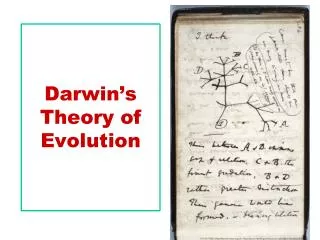
Theory: Evolution by natural selection produced the diversity of organisms we observe today. Prediction: Similarities must exist between species that originated from the same ancestor.
4 pieces of evidence for evolution show ways similarities are observed…
1. Homologous structures- Similar anatomical features that originated in a shared ancestor. • (NOT analogous structures- features that have identical functions but different internal anatomy and different development in the embryo)
2. Vestigial structures- structuresthat are useless to an organism but are similar to functional structures of related organisms or ancestors
3. Embryology- studying the early stages of development of an organism (inside the womb or inside the egg)