Gastrointestinal System
Gastrointestinal System. What is the Gastrointestinal System?. Digestion Mechanical and chemical breakdown of foods and the absorption of nutrients Mechanical digestion breaks large pieces into smaller ones without altering their chemical composition

Gastrointestinal System
E N D
Presentation Transcript
What is the Gastrointestinal System? • Digestion • Mechanical and chemical breakdown of foods and the absorption of nutrients • Mechanical digestion breaks large pieces into smaller ones without altering their chemical composition • Chemical digestion breaks food into simpler chemicals
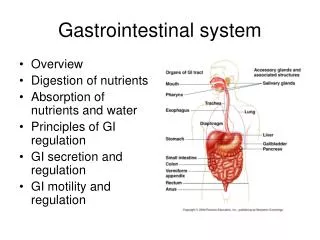
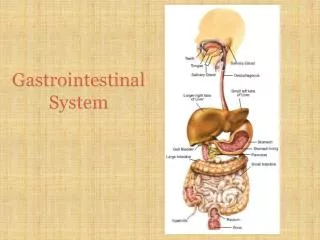
Alimentary Canal • Includes • Mouth, Pharynx, Esophagus, Stomach, Small Intestine, Large Intestine, Rectum, and Anus • Accessory Organs • Salivary Glands, Liver, Gallbladder, and Pancreas
Mouth • Tongue • Mixes food particles with saliva • Frenulum – connects the tongue to the floor of the mouth • Salivary Glands • Serous Cells • Secrete Amylase which breaks down glycogen • Mucous Cells • Secrete Mucus which lubricates food while swallowing
Pharynx and Esophagus • Passageways whose muscular walls function in swallowing • Pharynx connects the nasal and oral cavities with the esophagus • Esophagus connects the pharynx to the stomach • Lower Esophageal Sphincter closes the entrance to the stomach, preventing stomach contents from regurgitating • Peristalsis – a wavelike motion that propels food down a tube • A wave of contraction occurs, pushing down tubular contents • Both lined with stratified squamos epithelium
Stomach • J-Shaped pouch-like organ • Gastric Secretions • Chief Cells – Digestive enzyme pepsinogen • Parietal Cells – Hydrochloric Acid • Together form pepsin • Begins the digestion of all types of protein • Pyloric Sphincter • A muscular valve that controls gastric emptying into the Small Intestine
Small Intestine • Coiled mass filling most of the abdominal cavity inferior to the stomach and liver – about 6-7 m long • Simple Columnar • Receives secretions from the pancreas and liver, completes digestion of the nutrients in chyme, absorbs the products of digestion, transports the residues to the large intestine • Duodenum • Jejunum • Ileum
Digestion of Nutrients • Proteins and Peptides – Amino Acids • Lipids(fats) – Fatty Acids and Glycerol • Carbohydrates – Simple Sugars (monosaccharides)
Pancreas and Gallbladder • Pancreas • Secretes pancreatic juice which digests carbohydrates, fats, nucleic acids, and proteins • Pancreatic Lipase • Gallbladder • Absorbs/stores bile between meals • Bile • Yellowish-green liquid which breaks down fat globules into smaller droplets • Also enhances absorption of fatty acids, cholesterol, vitamins A, D, E, and K • Cystic Duct
Liver • General functions : • Carbohydrate metabolism • Lipid metabolism • Protein Metabolism • Storage • Blood filtering • Detoxification • Secretion
Large Intestine • About 1.5 m long • Lined with simple columnar epithelium • No longer digests food. Instead, absorbs vitamins created by bacteria • Consists of the colon, cecum, rectum, and anal canal(rectum) • Secretes mucus, absorbs water and electrolytes, forms and stores feces • Rectum uses peristaltic movement to remove fecal matter from the body
Links • http://www.wisc-online.com/objects/ViewObject.aspx?ID=NUR2403
What is Celiac Disease? • Digestive disease that damages the SI • Interferes with absorption of nutrients from food • Cannot tolerate gluten, a protein in: • Wheat • Rye • Barley • Some medicines • Some vitamins • Some lip balms • Mal-absorption and an abnormal reaction to gluten
What Happens? • If foods are eaten, or products are used that contain gluten, the immune system responds by damaging and/or destroying villi • Villi are tiny, fingerlike protrusions lining the SI that allow nutrients from food to be absorbed through the walls of the SI into bloodstream • Without villi, a person will become malnourished
What are the Symptoms? • Major Symptoms that occur • Abnormal bloating and pain • Chronic diarrhea • Vomiting • Pale, foul-smelling or fatty stool • Weight loss • Short status • Anemia • Bone/joint pain, arthritis, bone loss • Leads to liver diseases and cancers of the intestine
What Causes it? • Genetic • Can be triggered by: • Surgery • Pregnancy and childbirth • Viral infection • Severe emotional stress • People with celiac tend to have other disease: • Type 1 Diabetes • Autoimmune Thyroid Disease • Autoimmune Liver Disease • Rheumatoid Arthritis
Rate of Occurrence and Misdiagnosis • More than 2 million people in the US or 1 in 133 people • Has been long misdiagnosed, easily confused with: • Irritable Bowel Syndrome • Anemia • Inflammatory Bowel Disease • Diverticulitis • Intestinal infections • Chronic Fatigue Syndrome
How its Diagnosed and Treated • Blood tests are done for diagnosis • Biopsy of SI is performed, to check the damage of villi • Cheek swap samples check for DNA containing the Celiac Disease gene • However, there is no known cure • The best cure-> eliminate gluten from diet (i.e. read ingredient labels carefully
Comparison of Celiac Villi Celiac Villi Non-Celiac Villi
What is Crohn’s Disease? • Inflammation of digestive tract (inflammatory bowel disease) • Any area of the GI tract: mouth to anus • Usually affects the lower part of the SI, called the ileum • Swelling extends deep into the lining of the affected organ • Causes pain and makes the intestines empty diarrhea
What Happens? • Blockage of the intestine • Thickens intestinal wall (swelling and scar tissue, narrowing the passage) • Ulcers in the affected areas and into surrounding tissues • Nutritional complications also common in this disease • Deficiencies of proteins, calories, and vitamins are caused by the inadequate dietary intake, intestinal loss of protein, or poor absorption
What are the Symptoms? • Overall symptoms: • Abdominal pain in the lower right area • Diarrhea • Rectal bleeding • Weight loss • Arthritis • Skin problems • Fever • Children • Delayed development and stunted growth
Rate of Occurrence and Misdiagnosis • Genetic • More often in: • 20-30 years old • Jewish heritage • Can be difficult to diagnose because it is similar to other inflammatory bowel diseases, such as IBS
Diagnosis • Can be diagnosed through physical exams and a series of tests • Blood test may be done to check for: • Anemia, which could indicate bleeding in the intestines • A high white blood cell count, which is a sign of inflammation somewhere in the body • Testing a stool sample->reveal if there is bleeding or infection in the intestines • Further testing is required, such as a colonoscopy
Treatment • Differs by how severe: • Medications -> help control inflammation, correct nutritional deficiencies, and relieve symptoms • Most require surgery to remove inflamed tissue and treat complications • After surgery, there may be a period of remission but the disease tends to reappear over a person’s lifetime • However, disease is unpredictable-> no set treatment for the disease, range of medication and surgery depends on the severity
Diseases and Disorders (cont.) • Appendicitis • what it is- an irritation, inflammation, and infection of the appendix. occurs when inside becomes filled with mucus, stool, or parasites (causes swelling) • causes- pain, no purpose but if goes untreated it can burst and lead to infection • symptoms- stomach ache on right side • diagnosis-blood and urine test • most occur between ages 10 and 30 • treatment: removal