Download
1 / 5
60 likes | 202 Views
Explore the fundamental components of cells, including the unique phospholipid bilayer of archaea and the fluid mosaic model of cell membranes. Learn about passive and active transport mechanisms, and how the arrangement of nucleotides in DNA dictates amino acid sequences and protein production. Delve into the differences between prokaryotic and eukaryotic DNA organization, and understand the endosymbiosis theory explaining the origins of eukaryotic cells from prokaryotic ancestors. This tutorial provides a comprehensive overview of cellular structures.

E N D
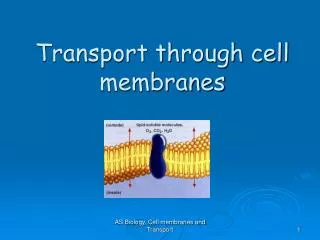
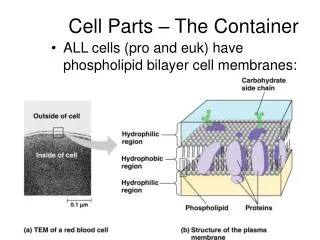
Cell Parts – The Container ALL cells (pro and euk) have phospholipid bilayer cell membranes:
BUT Archaea’s phospholipids are “backwards” (stereoisomers) and have chains (helpful against heat extremes?) Archaea (pro): Eukaryotes:
Cell Membrane: • The cell membrane is a “fluid mosaic” (membrane fluidity animation) • Membrane, passive transport, active transport animation
Cell Parts – The Instructions The arrangement of A’s,T’s,G’s, and C’s in DNA determines the order of the amino acids thus the proteins that the cell makes. Prokaryotes have their DNA in a circle. Eukaryotes have their DNA in the nucleus which is cut up into individual spaghetti like strands called chromosomes.
Origins of Eukaryotic Cells The Endosymbiosis theory Prokaryotes to Eukaryotes Tutorial