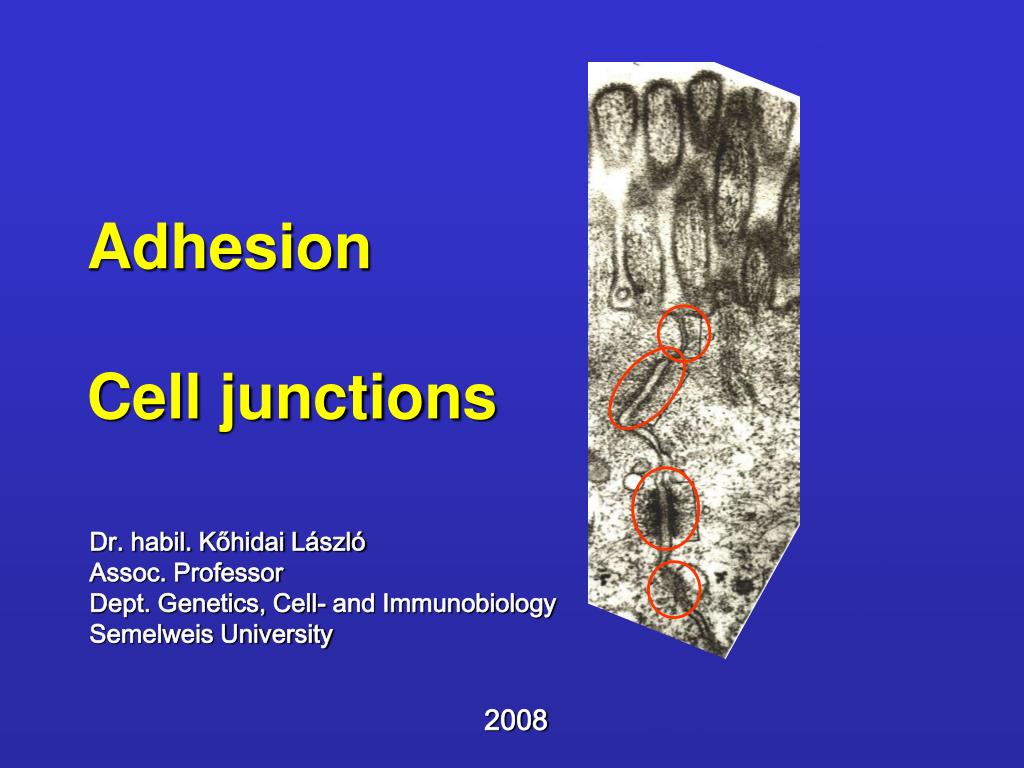
Adhesion Cell junctions. Dr. habil. Kőhidai László Assoc. Professor Dept. Genetics, Cell- and Immunobiology Semelweis University. 2008. Significance of cell-adhesion: formation of cell la yers. Significance of cell-adh es ion: Formation of multiple layers of cells.
An Image/Link below is provided (as is) to download presentation
Download Policy: Content on the Website is provided to you AS IS for your information and personal use and may not be sold / licensed / shared on other websites without getting consent from its author.Content is provided to you AS IS for your information and personal use only.Download presentation by click this link.While downloading, if for some reason you are not able to download a presentation, the publisher may have deleted the file from their server.During download, if you can't get a presentation, the file might be deleted by the publisher.
E N D
More Related Content
Presentation Transcript
Adhesion Cell junctions Dr. habil. Kőhidai László Assoc. Professor Dept. Genetics, Cell- and Immunobiology Semelweis University 2008
Main adhesion molecules expressed on the cells during adhesion • Cadhedrins homophil • Selectins heterophil • Integrins heterophil • Adh. mol. with immunoglobulin homophil domain { Ca2+
i.e. cadherin cyto- skele- ton i.c. linker prot. i.e. integrin ECM
Cadherin Ca2+ Ca2+ • Homophil connection • Cell-cell • Ca2+-dependent binding • I.c. anchored to actin or • intermedier filamentum • Significant role in • development • of vertebrates Ca2+ catenin • Tissue-specificity: • N - nerve • P - placenta • E - epithelial actin or IF
CAM = Cell Adhesion Molecules • 5 pcs. Ig-type domain • Ca 2+ indep. adhesion • Homophi connection - typical • Heterophil connection - rare • More than 20 variations • Expressed in the critical phase of • development Ig-like domains • Tissue-specificity: • N-CAM - neuron • L-CAM - liver In melanoma – relation between ICAM-1 density and the Metastatic activity of the tumour
Selectins Lectin type proteins, Carbohydrate specificity Tissue-specificity: E - epithelial L - lymphoid P - placenta L selectin: it has role in the initial phase of adhesion; in newborns the level of L sel. is low – the low number of inflammations (?!)
Integrin b • Ca2+-dependent binding • Heterophil connection • Focal contacts • Its i.c. linker proteins are • i.e.. talin, a-actinin, vinculin • RGD sequ. Is significant in • e.c. binding • Partner molecules: • fibronectin • laminin • collagen a S S Deficiency(b) – the adhesion of leukocytes affected, results the increase of inflammations
Role of tight junction • Mechanical connection • Barrier • Inhibits: • entry of water-soluble molecules • lateral diffusion of membrane-components • Ca2+ is required for the connections of occludins • Permeability: inorganic small substances • amino acids • monosaccharides
Septate junction • on the apical part of the cells • they form a continous belt (like z. adherens) • promote to stick together the cells • actin is anchored in this junction
Gap junction (1958, 1968) • Bridges the 2-4 nm gap between the neighbour cells • Hexagonal channel is formed (connexon) • The wall of the channel is composed by 6 connexins • (4 helical components) • The distribution of channels is tissue- or cell-specific • due to the difference of connexins • Accross channels substances are transmitted • (max MW. 1000) by a regulated mechanism
Role of gap junction • Transportofneurotransmitters, cAMP, • Ca 2+ • Signaling in early embryo
Plasmodesmata sER cytoplasm desmotubule cellwall membrane plasmodesmata Gap junction-like function Viral infection results in the increase of pore diameter
Collagen • Fibrils(diam.10-300 nm) • More than 15 types • I., II., III., V., XI. – formation of fibrils • IV., VII. – network • IX., XII. – association of fibrils
Synthesis and association of collagen filament synthesis of a-chain Pro, Lys hydroxilation glycosylation assembly organization into a fiber formation of triple helix secretion splitting of procollagen building into fibrill