Why API-First Development Matters for Startups
Modern startups rely heavily on external platforms such as payment gateways, analytics tools, cloud services, and marketing automation systems. API-first development makes these integrations more predictable and easier to manage.<br><br>Well-structured APIs allow startups to:<br><br>Integrate external services without disrupting core systems<br>Replace vendors with minimal refactoring<br>Expose their own services for partners or clients<br>For startups working alongside a software consultancy agency, API-first design ensures integrations remain clean and scalable as the product evolves.

Why API-First Development Matters for Startups
E N D
Presentation Transcript
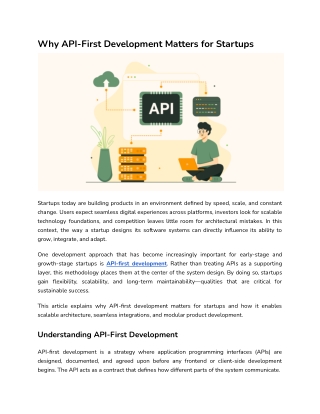
Why API-First Development Matters for Startups Startups today are building products in an environment defined by speed, scale, and constant change. Users expect seamless digital experiences across platforms, investors look for scalable technology foundations, and competition leaves little room for architectural mistakes. In this context, the way a startup designs its software systems can directly influence its ability to grow, integrate, and adapt. One development approach that has become increasingly important for early-stage and growth-stage startups is API-first development. Rather than treating APIs as a supporting layer, this methodology places them at the center of the system design. By doing so, startups gain flexibility, scalability, and long-term maintainability—qualities that are critical for sustainable success. This article explains why API-first development matters for startups and how it enables scalable architecture, seamless integrations, and modular product development. Understanding API-First Development API-first development is a strategy where application programming interfaces (APIs) are designed, documented, and agreed upon before any frontend or client-side development begins. The API acts as a contract that defines how different parts of the system communicate.
Instead of building a backend tightly coupled to a single user interface, API-first development creates a reusable service layer that can support multiple applications and integrations. Key principles of API-first development include: ● Designing APIs before building UI components ● Using standard specifications such as OpenAPI ● Treating APIs as products, not byproducts ● Ensuring documentation is created alongside development This approach shifts the focus from short-term delivery to long-term architectural stability. Why Startups Benefit from API-First Development 1. Scalability Built Into the Architecture Scalability is one of the biggest challenges startups face as they grow. Early technical decisions often determine whether a system can handle increased users, data, and features without major rework. API-first development supports scalability by decoupling the backend from the frontend. Backend services can be scaled independently based on demand, without impacting user-facing applications. As traffic increases or new features are introduced, the system remains flexible rather than fragile. This is why many teams guided by a top web design company emphasize API-first thinking when building digital products intended for long-term growth. 2. Faster Development and Parallel Workflows Speed is essential for startups competing in crowded markets. API-first development enables parallel workflows by allowing frontend and backend teams to work independently. Once API specifications are finalized: ● Backend developers focus on business logic and data processing ● Frontend teams build interfaces using mock or staged APIs ● Testing can begin earlier in the development lifecycle
This parallelism reduces delays, accelerates releases, and allows startups to respond quickly to market feedback. 3. Seamless Integration With Third-Party Services Modern startups rely heavily on external platforms such as payment gateways, analytics tools, cloud services, and marketing automation systems. API-first development makes these integrations more predictable and easier to manage. Well-structured APIs allow startups to: ● Integrate external services without disrupting core systems ● Replace vendors with minimal refactoring ● Expose their own services for partners or clients For startups working alongside a software consultancy agency, API-first design ensures integrations remain clean and scalable as the product evolves. Enabling Modular and Maintainable Development 4. Promoting Modular System Design API-first development encourages modular architecture by breaking functionality into well-defined services. Each module communicates through APIs, reducing dependencies between components. Benefits of modular design include: ● Easier maintenance and debugging ● Faster feature updates ● Reduced risk of system-wide failures This modularity is especially valuable for startups with small teams, where maintainability directly impacts development velocity. 5. Supporting a Transition to Microservices As startups scale, many transition from monolithic applications to microservices. API-first development provides a natural foundation for this evolution.
Each microservice exposes its functionality through APIs, enabling: ● Independent deployment cycles ● Targeted scaling of high-demand services ● Flexibility in choosing technologies for different services This approach is frequently used by teams collaborating with a web & app development company that specializes in building scalable, distributed systems. Improving Collaboration and Alignment 6. Clear Communication Between Teams Misalignment between product, design, and engineering teams can slow progress and introduce costly errors. API-first development reduces ambiguity by establishing clear system contracts early. With well-defined APIs: ● Product teams understand system capabilities and limitations ● Designers know what data is available and how it behaves ● Developers work from a shared source of truth This clarity improves collaboration and reduces rework, which is crucial in fast-paced startup environments. 7. Stronger Documentation and Developer Experience Documentation is often neglected in early-stage startups, but API-first development makes it a priority. APIs are documented as they are designed, ensuring accuracy and usability. Strong API documentation: ● Speeds up onboarding for new developers ● Reduces dependency on internal knowledge ● Enables smoother collaboration with external partners This is a key advantage for startups planning to scale their teams or offer developer-facing platforms.
Enabling Multi-Platform Digital Products 8. One Backend for Multiple Platforms Users expect consistent experiences across web applications, mobile apps, dashboards, and other interfaces. API-first development allows a single backend to serve all these platforms efficiently. This approach: ● Eliminates duplicated backend logic ● Ensures consistent data and behavior ● Simplifies expansion to new platforms It is particularly valuable for startups working with a mobile app development company, where shared APIs power both web and mobile experiences. 9. Future-Proofing the Product Technology evolves rapidly, and startups must adapt quickly to remain competitive. API-first development creates a stable core that allows teams to adopt new technologies without rewriting the entire system. Whether adding new interfaces, modernizing the frontend stack, or introducing advanced features, APIs act as a reliable backbone that supports innovation without disruption. Security, Performance, and Observability 10. Centralized Security Management API-first architectures allow security controls to be implemented consistently across all applications. Authentication, authorization, and access policies can be enforced at the API layer. This improves: ● Data protection ● Compliance readiness ● Visibility into system access
Centralized security is especially important for startups handling sensitive user or business data. 11. Better Performance Monitoring and Insights APIs provide clear visibility into how systems are used. By monitoring API activity, startups can identify performance bottlenecks, usage patterns, and feature adoption trends. These insights support: ● Proactive optimization ● Faster issue resolution ● Data-driven product decisions Understanding real usage helps startups focus development efforts where they matter most. When API-First Development Makes Sense API-first development is particularly well-suited for startups that: ● Plan to scale rapidly ● Need to support multiple platforms ● Rely on integrations as a core part of the product ● Want to minimize long-term technical debt While it requires more planning upfront, the long-term benefits far outweigh the initial investment. Conclusion: Building Scalable Startup Products With API-First Development API-first development gives startups a strategic advantage by enabling scalable architecture, seamless integrations, and modular development. By designing systems around well-defined APIs, startups can move faster, adapt more easily, and build products that are ready for growth from day one. Rather than treating APIs as a secondary concern, successful startups recognize them as the foundation of modern digital products.
At Atini Studio, we help startups design and build scalable digital solutions using API-first development principles. By focusing on clean architecture, performance, and long-term maintainability, Atini Studio supports startups in creating products that are not only functional today but ready for tomorrow’s challenges.