Download
1 / 1
10 likes | 133 Views
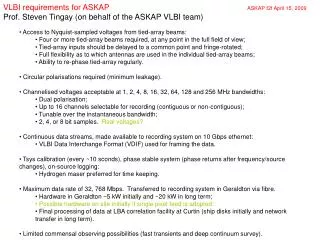
This document outlines the requirements for accessing Nyquist-sampled voltages from tied array beams, essential for Very Long Baseline Interferometry (VLBI). It specifies the need for four or more tied array beams, fringe rotation, and flexible antenna selection. The system supports dual polarisation and multiple selectable channels for recording at various bandwidths. Key features include continuously available voltage streams over 10 Gbps Ethernet, Tsys calibration, and a maximum data rate of 32.768 Mbps. The document also addresses hardware specifications and processing logistics.

E N D
Access to Nyquist-sampled voltages from tied-array beams: • Four or more tied-array beams required, at any point in the full field of view; • Tied-array inputs should be delayed to a common point and fringe-rotated; • Full flexibility as to which antennas are used in the individual tied-array beams; • Ability to re-phase tied-array regularly. • Circular polarisations required (minimum leakage). • Channelised voltages acceptable at 1, 2, 4, 8, 16, 32, 64, 128 and 256 MHz bandwidths: • Dual polarisation; • Up to 16 channels selectable for recording (contiguous or non-contiguous); • Tunable over the instantaneous bandwidth; • 2, 4, or 8 bit samples. Real voltages? • Continuous data streams, made available to recording system on 10 Gbps ethernet: • VLBI Data Interchange Format (VDIF) used for framing the data. • Tsys calibration (every ~10 sconds), phase stable system (phase returns after frequency/source changes), on-source logging: • Hydrogen maser preferred for time keeping. • Maximum data rate of 32, 768 Mbps. Transferred to recording system in Geraldton via fibre. • Hardware in Geraldton ~5 kW initially and ~20 kW in long term; • Possible hardware on site initially if single pixel feed is adopted; • Final processing of data at LBA correlation facility at Curtin (ship disks initially and network • transfer in long term). • Limited commensal observing possibilities (fast transients and deep continuum survey). VLBI requirements for ASKAP ASKAP f2f April 15, 2009Prof. Steven Tingay (on behalf of the ASKAP VLBI team)