Reconstruction
The Reconstruction period (1865-1877) was a complex and transformative time in American history following the Civil War. During this era, the U.S. sought to rebuild and readmit Southern states, with significant challenges arising from differing views on the process. President Lincoln's lenient approach and Radical Republicans' push for extensive reforms created tensions. Key developments included the Freedmen's Bureau's assistance to newly freed slaves, the Civil Rights Act of 1866, and the 14th and 15th Amendments aimed at establishing rights and protections for African Americans. Ultimately, Reconstruction faced numerous obstacles, leading to a mixed legacy.

Reconstruction
E N D
Presentation Transcript
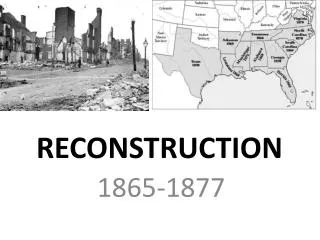
Reconstruction • 1865-1877 • Very complicated period of time during which the US: • Began to rebuild after Civil War • Readmitted southern states • Lots of disagreement on process
Lincoln’s plans • Intended to be lenient to southerners & southern states • If states weren’t legally allowed to secede, they never actually did • People rebelled, not states • Individual people can be pardoned by the president
Lincoln’s 10% Plan • Proclamation of Amnesty & Reconstruction (Dec 1863) • All rebels pardoned except: • High ranking Confederate officials • Accused of mistreatment of POWs • State could rejoin union if 10% of 1860’s voters swore allegiance
Dissent to Lincoln’s Plan • Radical Republicans wanted to: • Seize former slaveholders’ property • Redistribute seized property to freed slaves • Give former slaves full citizenship • Allow former slaves to vote
Radical Republican leaders Thaddeus Stevens (PA) & Charles Sumner (MD)
Andrew Johnson (TN) • 17th president • Took over after assassination • Dem – picked by Lincoln to be VP for national unity
Andrew Johnson (TN) • Only southern senator to remain loyal to US • Strong abolitionist • Hated plantation owners – thought war was their fault
Andrew Johnson (TN) • Universally hated • Southerners hated him – traitor • Radical Reps hated him – dirty southerner
Presidential Reconstruction • Johnson’s plan for reconstruction • States would be readmitted if they: • Withdraw secession • Swear allegiance to union • Cancel war debts against US gov • Ratify 13th amendment
Presidential Reconstruction • Not included in plan: • Land rights for freed slaves • Voting rights for freed slaves • Legal protection for freed slaves • Radical Republicans were upset that these were missing
Presidential Reconstruction • Southern states quickly followed his instructions • Held conventions: • Wrote new state constitutions • Set up new state governments • Elected new Congressmen
End of Pres Reconstruction • Congress refused to admit new southern congressmen • Almost all of them were either former CSA congressmen or CSA military officers
Freedmen’s Bureau • Congress proposed bill to continue & increase work of FB • Assisted former slaves & some poor whites in south • Distributed clothes & food • Built hospitals & schools
Civil Rights Act of 1866 • Congress proposed bill to give freed slaves basic rights • Would make freedmen citizens • Would outlaw discriminatory laws like Black codes
Black Codes • Postwar laws in south restricting rights of blacks: • Ownership of property • Carrying weapons • Interracial marriage • Serving on juries • Testifying against whites • Ability to move or travel
Johnson’s vetoes • Andrew Johnson vetoed: • Freedmen’s Bureau law • Civil Rights Act • Angered moderate Republicans who had been on his side
Congressional Reconstruction • Moderate & Radical Republicans joined forces • Overrode veto of Civil Rights Act • Wrote 14th Amendment
14th Amendment • Everyone born within the boundaries of US is a citizen • Citizens have equal protection of the law • Did not include right to vote
1866 Congressional election • Johnson campaigned for congressional candidates who would support him • Campaigned with Ulysses Grant • Public loved Grant, hated Johnson
1866 Congressional election • Race riots erupted all around south • Fear that national government would step in to protect former slaves • Republicans won huge majority in Congress • Could override president’s vetoes
Reconstruction Act of 1867 • Abolished new state govs formed in former CSA • Divided south into 5 military districts headed by union generals • States had to guarantee blacks’ voting rights to be readmitted
Reconstruction Act of 1867 • Johnson vetoed act • Congress overrode Johnson’s veto • Johnson vowed not to enforce act
Impeachment • Radical Republicans wanted to impeach Johnson for not enforcing Reconstruction Act • Was formally accused of misconduct in office
Tenure of Office Act • Congress passed law saying: • President can’t fire a former president’s cabinet member unless Senate ok’s it • Johnson fired Secretary of War Edwin Stanton
Impeachment • House impeached Johnson • Accused him of wrongdoing • Senate did not have the 2/3 vote required to expel Johnson • 1 vote away from kicking him out
15th Amendment • Passed in 1870 • No one can be denied suffrage because of: • Race • Color • Previous condition of servitude
Postwar in the South • By 1870, all southern states readmitted to union • State govs were all Republican • Dems & Confeds were not given positions of power
Physical & economic conditions • Property values plummeted • Land was destroyed • People who held CSA bonds or held CSA $ were out of luck • All southerners (exc freedmen) poorer than before war
Public works programs • Congress did all this stuff: • Built roads, railroads & bridges • Built orphanages, public schools & hospitals • Expected states to help pay for projects • But they couldn’t afford it
Politics in postwar south • Scalawags • Southern insult for southerners who joined the Republicans • Many trying to get ahead economically • Small farmers looking for a way to get a leg up on wealthy planters
Politics in postwar south • Carpetbaggers • Southern insult for yankees who came down to exploit poor southerners • Some worked for Freedmen’s Bureau & came to help • Some wanted to start new businesses & industries in area
African American voters • 90% of Black voters Republican • Large numbers of blacks registered to vote • Sometimes outnumbered whites
Changes in voting • High # of blacks voting alarmed scalawags • Many didn’t believe in civil rights and started voting for Democrats
Republicans react • Republicans gave jobs to some Democrats • Trying to convince southern whites to vote Republican • Didn’t convince them, just alienated black voters
Education • 80% of freedmen had been illiterate • Had been illegal to teach them to read • Many early professors & teachers were northern whites • Schools & colleges formed by Freedmen’s Bureau & churches • Like Morehouse College in ATL
Hiram Revels (R, MS) • 1st black senator • 1 of 16 black Congressmen during Reconstruction • Minister • Had served as captain in union army
Restoration of plantations • People who wanted to restore plantations to original owners: • Planters whose land was taken • Northern textile merchants who did business with them • Poor southern whites wanting to stay superior to blacks
Sharecropping • Landowners subdivided land into small plots • Gave workers land, seed, tools • Owners took ~50% of crops
Tenant farming • Farmers pay rent for the land, keep all of the crops • Only if they can save up the $ • Very few sharecroppers could
Economic depression • Demand for cotton dropped • Dropped prices • Foreign countries found other sources for cotton they needed • Southern planters overreacted & planted too much cotton • Drove prices down even more
Economic depression • Planters couldn’t repay loans • Banks failed • No $ available for new loans • People couldn’t buy land, tools, start businesses, etc. • People stayed poor
Opposition to reconstruction • Some southern whites violently opposed Republicans & blacks • Most southern whites just went about their business
KKK • Originally a social club for former confederates • Expanded rapidly through south • Some local groups became violent terrorist organizations
KKK • Used intimidation – stop blacks from exercising political rights • Threatened whites who helped or did business with blacks too
KKK in southern elections • KKK’s intimidation so bad that most blacks didn’t vote at all • Dems eventually won elections for control over south • Then changed voting laws to restrict black voting
Congress vs. the KKK • Enforcement Acts 1870-1871 • Southern elections monitored • President could send troops to put KKK down
KKK’s decline • Declined because they mostly got what they wanted • Dems got back total control • Blacks had rights taken away • No need to keep fighting
Amnesty Act (1872) • Allowed 150,000 former confederates to vote again • Mostly voted for Democrats
U.S. Grant’s Scandals • President Grant was one of the worst presidents in history • Put corrupt people in positions under him – personal friends • Left them alone to ruin things