Effective Quotation Integration in Literary Analysis
To enhance your literary arguments, it is essential to smoothly integrate quotations into your writing. Always introduce quotations with context and ensure they are grammatically incorporated into your sentences. Avoid leaving quotations "hanging" without an introduction or violating grammar rules. Each quotation should be followed by commentary that assesses its significance in relation to your argument. This method not only strengthens your analysis but also showcases your understanding of character, theme, or stylistic elements in the text.

Effective Quotation Integration in Literary Analysis
E N D
Presentation Transcript
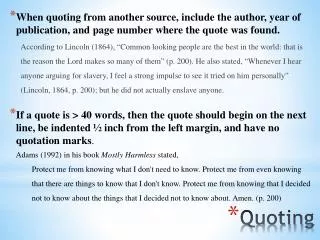
Documentation • Place the page or line number in a parenthesis after the quotation: Jane Eyre speaks to her master boldly, "You are human and fallible" (129).
Introducing quotations Introduce every quotation smoothly and grammatically into a statement of your own. Do not leave the quotation hanging with no introduction, and do not violate the rules of grammar to include the quotation. The second example below is a fused sentence. • WRONG (NO INTRODUCTION): Macbeth has changed. "Out, out, brief candle!" (5.5.23). • WRONG (UNGRAMMATICAL): Macbeth has changed "Out, out, brief candle!" (5.5.23). • RIGHT: A changed man, Macbeth wearily exclaims, "Out, out, brief candle!" (5.5.23).
Your sentence must comment on the significance of the quotation Do not just introduce your evidence. Just as an attorney shows a jury a forged check or murder weapon, a literary critic shows the reader evidence--a word, a series of phrases, a paragraph--to prove a point about character, theme or style. As you quote, clearly indicate the context of the passage and the purpose it serves in your argument. Your sentence should include commentary:
WRONG (NO COMMENTARY): Macbeth says, "Out, out, brief candle!" (5.5.23). • RIGHT: Upon hearing that his wife has died, Macbeth can only cry, "Out, out, brief candle!" (5.5.23), for life now seems to him no more than a flame that quickly vanishes.