Plant Structures
Plant Structures. Original PowerPoint crated by Mr. Morgan Modified by Georgia Agriculture Education Curriculum Office June 2002. What Are primary parts of plants?. Leaves Stems Roots Flowers. What are the functions of leaves?. Capture light Exchange gases

Plant Structures
E N D
Presentation Transcript
Plant Structures Original PowerPoint crated by Mr. Morgan Modified by Georgia Agriculture Education Curriculum Office June 2002
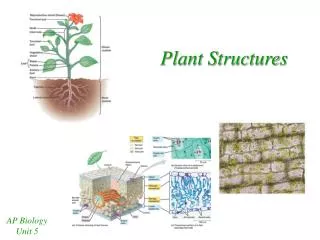
What Are primary parts of plants? • Leaves • Stems • Roots • Flowers
What are the functions of leaves? • Capture light • Exchange gases • Provide a site for photosynthesis • Some leaves store food and water • Some form new plants and provide support
What is photosynthesis? • It is a process by which plants combine water and carbon dioxide in the presence of chlorophyll and sunlight and produce carbohydrates and release oxygen.
Why is photosynthesis important? • Light is the most important source of energy for living things. Photosynthesis converts light into nutrients that can be used by plants and animals. • Releases oxygen
Photosynthesis • Light+6CO2+12H20-Sunlight-> C6H1206+6O2+6H20
There are two parts of photosynthesis--the light and dark reactions. • The light reactions produce chemical energy from light. • The dark reactions convert carbon dioxide into carbohydrates.
Leaves in gas exchange • Oxygen, Carbon Dioxide, and Water exchanged from Stomata • Pores open in day to transpire H2O and allow gases to enter • Close during dry conditions to prevent H2O loss.
External Parts of Leaves • Petiole- Stalk of leaf that attaches to stem • Midrib- Main vein of vascular tissue • Blade- Photosynthetic site of leaf
Stomata • Openings on the epidermis • allows air into leaf • allows H2O and oxygen out of leaf
Stems • Water and mineral transport by capillary action and cohesion to the leaves. • Transport food to the roots • Gas exchange • Produce and support new leaves, branches, and flowers
Internal parts of stem • Phloem • Xylem • Cambium • Pith • Cortex
Functions • Phoem-Sugar and carbohydrates to roots • Xylem- Water and nutrients • Cambium- Growing part of stem
Function Cont’ • Pith-Occupies the central area of the stem • Cortex- Composed of several layers of thick-walled cells
External parts of stem • Buds • Nodes • Internodes
Modified Stems • Rhizomes- Horizontal underground stems(Bermuda Grass • Stolons- Horizontal above ground stems(strawberries) • Tubers- Greatly enlarged tip of underground stem
Cont. • Bulbs- budlike structure consisting of a small stem (onion) • Corms- Fleshly leaves underground stems with few nodes(gladiolus)
Functions of Roots • Anchor plants in soil • Absorb water and nutrients • Some store reserves for future uses(Potato) • Propagation
Advantages Penetrates deeper Obtain water from other levels Anchor plant Disadvantages Difficult to remove or harvest do not stabilize well Taproots
Advantages Shallower, better for fertilization & Water Stabilize in soil better Disadvantage Less drought resistant Tend to get exposed during cultivation Fibrous
Primary Roots • Grow down into the soil and may branch repeatedly into lateral roots • Taproot is a primary root
Lateral Roots • Called Secondary roots • grow horizontally away from the primary root • Some grow downward
Adventitious • Came from stems or leaves instead of another root • Prop root of corn and grapes are examples that give support
Fibrous Root • Root structures in which the primary and lateral roots develop equally so there is not a definite taproot.
Storage Roots • Are structures such as those of carrots and sweet potatoes which are used for food storage.
What do stems and roots have in common? • Both have xylem and phloem cells for transport.
Male flowers and their parts and functions. • Stamen- has two parts- filament and antherFilament- supports the anther • Anther- Produces pollen grains
Female parts and their functions • Ovule-develops into a seed • Ovary- surrounds the ovule, later becomes the fruit • Style-supports the stigma • Stigma- receives the pollen grain • Pistil- All three female parts together
Other parts of flower • Receptacle- enlarged part of the flower stalk where floral part is. • Sepals- outer protective parts of buds • Petals- the colored part of the flower used to attract insects
Complete Flower • Both have Male and Female parts
Incomplete Flowers • Have either male or female parts but not both
Monoecious • Plants that have male and female flower parts on separate plants
Dioecious • Have both parts on the same plant.
Pollination • The transfer of pollen from one anther to anther stigma. • Two ways- self-pollination & Cross-pollination • Bees and Wind