Cutting-Edge Ground-Based VLBI and GNSS Infrastructure for Enhanced Astrophysical Observations
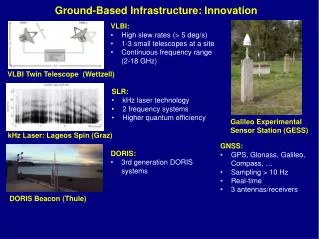
This project focuses on advancing ground-based infrastructure for Very Long Baseline Interferometry (VLBI) and Global Navigation Satellite Systems (GNSS). It highlights innovative technologies such as high slew rates exceeding 5 degrees per second and the integration of multiple small telescopes at a single site. Key systems include the VLBI Twin Telescope at Wettzell, advanced kHz laser technology for satellite laser ranging (SLR), and next-generation DORIS systems. With capabilities to sample over 10 Hz in real-time using three antennas, this infrastructure enhances observational precision and data quality.

Cutting-Edge Ground-Based VLBI and GNSS Infrastructure for Enhanced Astrophysical Observations
E N D
Presentation Transcript
Ground-Based Infrastructure: Innovation VLBI: • High slew rates (> 5 deg/s) • 1-3 small telescopes at a site • Continuous frequency range (2-18 GHz) VLBI Twin Telescope (Wettzell) SLR: • kHz laser technology • 2 frequency systems • Higher quantum efficiency Galileo Experimental Sensor Station (GESS) kHz Laser: Lageos Spin (Graz) GNSS: • GPS, Glonass, Galileo, Compass, … • Sampling > 10 Hz • Real-time • 3 antennas/receivers DORIS: • 3rd generation DORIS systems DORIS Beacon (Thule)