Understanding Inductive and Deductive Reasoning in Geometry
This lesson focuses on simplifying mathematical expressions, exploring the concepts of inductive and deductive reasoning, and using geometric patterns. Students will simplify the expression 6-3x4-{18-10÷2} and explore various types of reasoning through real-world examples. By making conjectures and counterexamples, students will strengthen their analytical skills. Additionally, they will work together to find patterns in sequences and apply their understanding to predict future terms, encouraging collaboration and critical thinking in mathematics.

Understanding Inductive and Deductive Reasoning in Geometry
E N D
Presentation Transcript
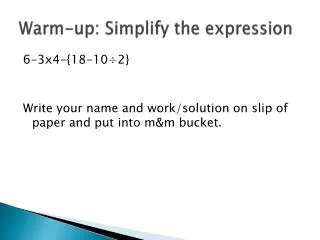
Warm-up: Simplify the expression 6-3x4-{18-10÷2} Write your name and work/solution on slip of paper and put into m&m bucket.
1.1: Basic Ideas and Tools of Geometry LEQ: How do we analyze and/or use patterns or relations?
Inductive Reasoning: Making broad generalizations from specific examples Ex. The first 8 people came in wearing blue, so everyone will be wearing blue. Deductive Reasoning: Using a general statement or broad idea to draw conclusions about specific things. Ex. Honor’s classes are challenging, so this class will be challenging.
Conjecture: to make a conclusion based on inconclusive evidence Ex. All blondes are dumb. Counterexample: anything that disproves a statement Ex. The sum of any 2 even number is always odd. Counterexample: 6+2=8 and 8 is even
Take out a sheet of paper Write 4 sentences, each demonstrating an example of each vocab word (inductive reasoning, deductive reasoning, etc.)
Example 1 Find a pattern for each sequence. Use the pattern to find the next two terms in the sequence. • a. 3, 6, 12, 24, _____, _____ • B.