Download
1 / 17
170 likes | 286 Views
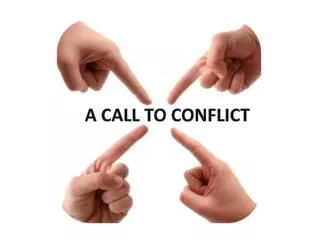
A CALL TO CONFLICT. INTRODUCTIONS. What is Conflict?. What is Conflict?. Often has negative images, symbols or metaphors associated with it It is normal and does not always have a negative association It can be growth and positive change. A CALL TO CONFLICT. Elements of Conflict.

E N D
What is Conflict? • Often has negative images, symbols or metaphors associated with it • It is normal and does not always have a negative association • It can be growth and positive change A CALL TO CONFLICT
Elements of Conflict • Conflicts are typically composed of three elements: • People- the relational and psychological elements of the conflict • Process- the way decisions get made and how people feel about it • Problems- the specific issues and differences people have between themselves A CALL TO CONFLICT
Consider Conflict As… • Given that conflict is a given, why do we often run from it? • Avoidance of confrontation, fear • For indeed, when we came to Macedonia, our bodies had no rest, but we were troubled on every side. Outside were conflicts, inside were fears. • 2 Corinthians 7:5 • Conflicts often do not go away on their own
Consider Conflict As… • There is always something to learn in the midst of conflict about ourselves and others • What might happen if we viewed conflict as an opportunity to learn something new about God? • If we know there is a better way (the Gospel News) why doesn’t Christ’s church show and tell the world how conflict can be a vehicle for Transformation, Change and Resurrection?
Conflict Dynamics • Problem Solving and Dialogue • Other Person Seen as the PROBLEM • Issue Proliferation • Language Changes as Conflict Escalates • Triangles • Escalation and Reaction • Hostility Increases • Polarization
A Procedure for Discussing Interpersonal Disagreements • Establish a procedure for discussion and ensure everyone understands • List one or several things you disagree on or wish to clarify • Begin to allow a speaker give a brief statement • Allow those that are listening provide a summary of the statement given(repeat the process for the speaker and listener; until all views have been made and understood)
A Procedure for Discussing Interpersonal Disagreements • Identify what can be agreed upon • Identify the main concerns • Search for several options to resolve or meet concerns • Put together a solution or plan for the options above
CART Team(Congregational Assessment, Response and Transformation Team)
CART TeamCongregational Assessment, Response, Transformation CRISIS CONFLICT A congregation in the midst of conflict does own a share in what has transpired. The Conflict CART Team will be deployed with the congregation paying ½ of the costs and the CLD the other ½ of the cost of assessment, mileage and response. • A crisis by definition is something that arises in a congregation over which they had no control. • The Crisis CART Team can be deployed at no cost to the congregation, agency or institution.
Questions??? www.ntcleadingfromthecenter.org