The Progressive Era
The Progressive Era marked a transformative period in American history from 1901 to 1918, characterized by a powerful movement led by middle-class citizens advocating for reforms in social, political, and economic systems. Key issues included women's suffrage, prohibition, labor rights, consumer protection, and the regulation of trusts. Prominent figures like Theodore Roosevelt and reformers like Upton Sinclair played crucial roles in addressing corruption and injustices. The era also saw pioneering legislation such as the Pure Food and Drug Act and the establishment of the Federal Trade Commission.

The Progressive Era
E N D
Presentation Transcript
The Progressive Era 1901-1918
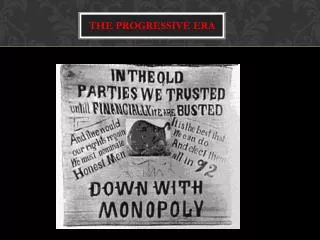
Who were the “Progressives”? • Generally middle-class residents of US cities representing a diversity of interests… • Women’s suffrage, prohibition, social welfare, voting reforms, labor, political machines, municipal reform, trust-busting, railroad regulation, consumer protection, conservation, civil rights
Why Now? • What is the population like? Demographics? Population density? • Who is president? • What is happening with industry? With business?
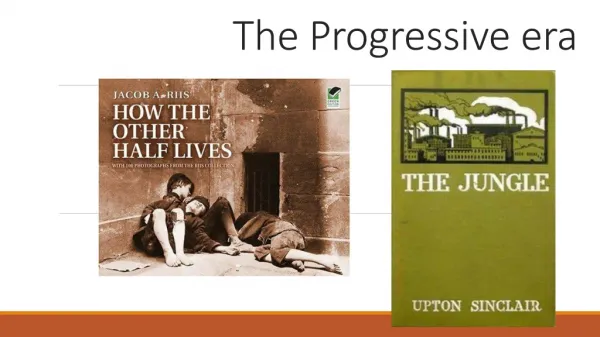
Jacob Riis- How the Other Half Lives Jacob Riis- How the Other Half Lives
Jacob Riis- How the Other Half Lives How the other half lives
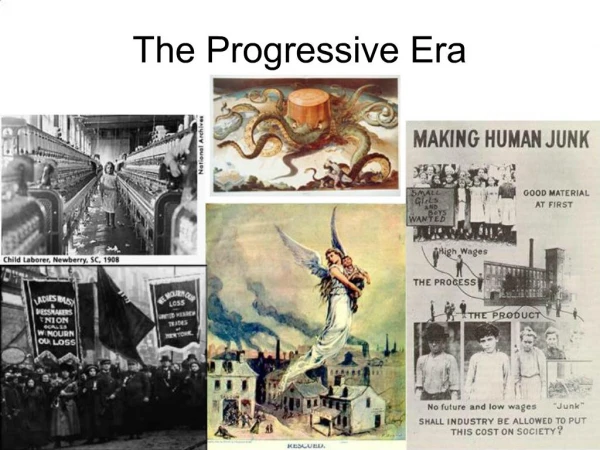
Muckraking…the New Yellow Journalism? Yellow Journalism Muckraking
Make your own campaign • Consider the intent behind yellow journalism and muckraking, how do you see it in play today? • Take out a sheet of paper and create your own example. • Use a catchy or sensationalized title to draw the viewer in • Think about what your intent is in the ad • Examples will be hung up around the class
Political Reforms • Australian (secret) Ballot • Direct primaries • Social welfare • Direct election of US Senators • Initiative, referendum, recall
Roosevelt’s Square Deal • Presidents usually took side of business during labor conflicts, Roosevelt sought a square deal for business and labor • Anthracite coal strike- 1902 • Called union leaders and mine owner to white House • Owners refused to compromise, so Roosevelt threatened to take the mine over. • 10% wage increase, 9 hour workday, no union recognition
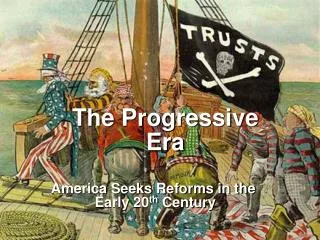
Roosevelt’s Trust-Busting • Enforced Sherman Antitrust Act of 1890 • Northern Securities Company • 40 other large, “bad trusts”
Consumer Protection-1906 • Pure Food and Drug Act- prevented food and drugs from being inferior or misleadingly labeled • Meat Inspection Act- allowed federal inspectors to ensure sanitation standards
Election of 1908 • Republican Candidate- William Howard Taft • Democratic Candidate- William Jennings Bryan…again Sorry WJB…
Taft the Successor • Brought 90 suits against trust vs. Roosevelt’s 44 • Standard Oil Company • U.S. Steel- Roosevelt took it personally • Mann-Elkins Act (1910)- ICC can suspend railroad rates, and oversee telephone, telegraph, and cable companies • 16th Amendment (1913)- US govt. can collect an income tax
Trouble in Progressive-ise • Payne-Adrich Tariff • Pinchot-Ballinger Controversy • House Speaker Joe Cannon • Midterm Elections of 1910
Exit Ticket • Why did the “Progressive Era” begin in 1901?
The Bull-Moose • “My hat is in the ring!” • “The fight is on and I am stripped to the buff!” • Conservative Republicans block Rooseveltites in the nominating convention • TR gets nominated at a Progressive Republican Convention
Election of 1912 Woodrow Wilson Democrat William Howard Taft Republican Theodore Roosevelt Bull-Moose Party
Roosevelt’s New Nationalism • Greater government regulation of businesses and unions • Women’s suffrage • Social welfare programs
Wilson’s New Freedom • Limit big business and big government • End corruption • Support small business • Free functioning of unregulated and unmonopolized markets
Results • Wilson-435 electoral votes, 41% • Roosevelt-88 electoral votes, 27% • Taft-8 electoral votes, 23% • Debs- None, 6%
Wilsonian Progressivism • Dynamic chief executive role • Against “triple wall of privilege”- tariffs, banking, trusts • Underwood Tariff-significantly lowered tariffs, paid for by graduated income tax rate
Wilsonian Progressivism • Clayton Antitrust Act- strengthened Sherman Antitrust Act, exempts unions from being prosecuted as trusts • Federal Trade Commission- power to take action against any “unfair trade practice” • Federal Farm Loan Act- established 12 regional federal farm loan banks • Child Labor Act- prohibits shipment of products manufactured by children under 14
Progressive Roulette! • Temperance • Women’s Suffrage • Socialism • Civil Rights • Labor • Social Welfare