The Progressive Era
The Progressive Era (1900-1916) marked a pivotal moment in American history as social reformers sought to address the increasing gap between rich and poor, amid a backdrop of rapid urbanization and significant immigration. Key events, such as the Triangle Shirtwaist Fire of 1911, ignited public consciousness and activism. Progressive activists, including muckrakers and the burgeoning labor movement, spotlighted harsh living conditions and injustices. Influential leaders like Theodore Roosevelt and Woodrow Wilson navigated reforms that would reshape labor laws, women's rights, and economic policies, pushing for equality and social justice.

The Progressive Era
E N D
Presentation Transcript
The Progressive Era 1900-1916
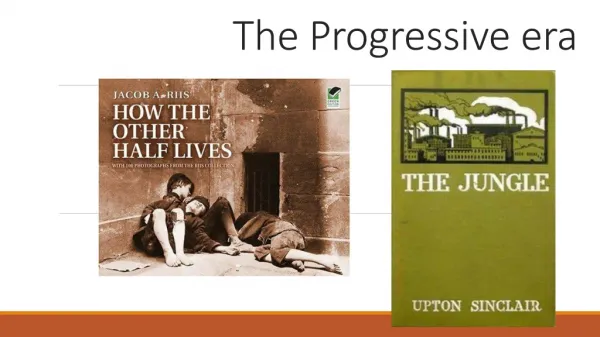
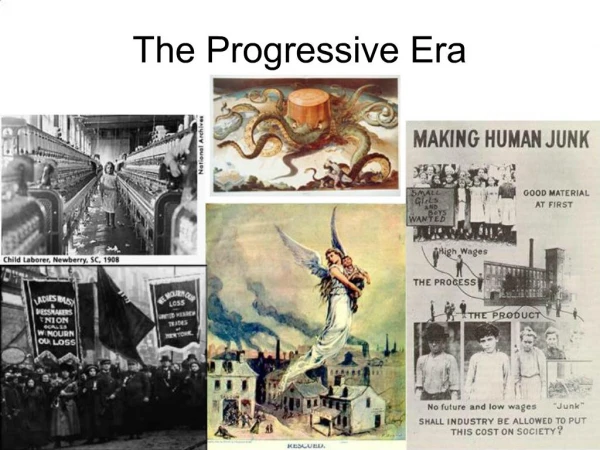
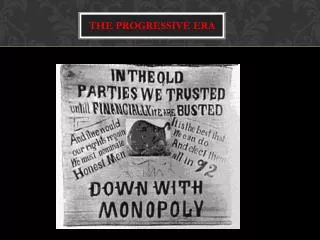
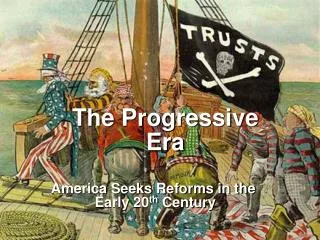
An Urban Age • Triangle Fire, 1911-Had an unrivaled impact on Public Consciousness • Gap between rich and poor increased, 1900-1916 • J.P. Morgan’s financial firm controlled 40 percent of all financial and industrial capital in U.S. • Progressive-Loosely defined political movement of individuals and groups who hoped to change American political and social life • Muckrakers-Journalists who exposed the “underside” of American life (harsh living conditions, child labor, e.g.)
Immigrant Quest for Freedom • Period characterized by major immigration (35 million people, mostly from Europe) • In 1900, 1,000 foreign language newspapers published in United States • 1 in 7 Americans and 3/5 of factory laborers were foreign born in 1910 • “My people are not in America, they are under it” –Slavic priest, p. 732 • Discrimination against Jews, Irish, Southern/Eastern immigrants-some groups were denied access to schools and victims of policy brutality, especially if they were strikers
American Lifestyle • Rise of mail order business and department store • Advertising permeated public life • More women entered workplace as secretaries and telegraph operators • Rise of Fordism • Unheard of $5 wage 1914 • Assembly line • Affordable cars • Philosophy “the worker must be able to afford an American lifestyle”
Varieties of Progressivism Progressives: • Wanted Industrial freedom-Political liberty vs. Industrial slavery • Some turned to socialism. Socialists wanted a free college education, legislation to improve labor conditions and public ownership of railroads and factories. • Socialist Eugene V. Debs ran for president in 1912 (only gained 6 percent of the vote.) • Some joined the AFL American Federation of Labor(1.6 million members) and IWW Industrial Workers of the World p. 745
Native Americans • Native American progressives wanted freedom and citizenship • Carlos Montezuma, founder of the Society of American Indians, wanted the Bureau of Indian Affairs abolished • Advocated freedom and citizenship for his people
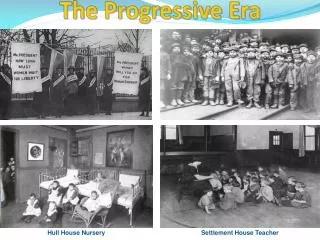
Women • Female progressives: 20,000 women garment workers striked in 1909(including the Triangle Shirt Waist Company women who later perished in the fire) • “New Feminism” –women wanted birth control, free sexual expression, reproductive choice AND the right to vote • The IWW and Socialist party supported Margaret Sanger’s birth control movement • Other women advocated social change • Jane Addams and Hull House p. 752 • Built kindergartens and playgrounds for children, established settlement houses for immigrants • Julia Lathrop headed the Children’s Bureau (1912) • 2 million women were members of the National American Women Suffrage Association by 1917
Politics of Progressivism • The influence of socialism from Europe: The term “social legislation” meaning government action to address urban problems, originated in Germany with the writings of Karl Marx. • State and local governments increased property taxes to fund public property: parks, schools, public utilities • Alarmed by the upsurge in violent class conflict and the unrestricted power of corporations, Progressives believed that political reforms could help unite the nation • Progressives were in both the Democratic and Republican parties at the time and did not form their own party until 1912
Progressive Presidents • Theodore Roosevelt • Became president after McKinley was assassinated in 1901, re-elected in 1904 • Good vs. Bad corporations • Prosecuted Northern Securities Company (railroads) under Sherman Antitrust Act • In 1904, Supreme Court ordered Northern Securities dissolved • Under Roosevelt, the Hepburn Act, Pure Food and Drug Acts were passed (see p. 765’s table) • First president to support conservation-creation of natural parks to preserve natural beauty in the U.S.
Progressive Presidents • Taft elected in 1908, defeating William Jennings Bryan • Attacked big business including Standard Oil and American Tobacco • Ratified 16th Amendment which enacted a graduated income tax (tax higher for wealthier citizens) • Signed Payne-Aldrich Tariff-reduced rates on imported goods
Election of 1912 • See p. 761 • Four way race democrat, republican, socialist, progressive • Former Pres. Roosevelt ran for the Progressive Party because Taft wasn’t environmentally conscientious and was too conservative • Wilson (Democrat) won
Wilson’s version of Progressivism • Underwood Tariff-reduced duties on imports substantially • Graduated income tax on richest 5 percent • Clayton Act 1914-helped strikers • Keating-Owen Act of 1916 outlawing child labor • Adamson Act established 8 hour workday on railroads • Warehouse Act, extended credit to farmers • Established Federal Reserve System and Federal Trade Commission • The seventeenth amendment was ratified by the states in April of 1913. It took the election of senators from the state legislators and made it a popular vote by the people of the states. • Please read pgs. 761-762 (last two pages of the chapter) in detail to better understand Wilson’s reforms