Download
1 / 14
140 likes | 246 Views
This text explores the principles of spontaneity in chemical processes through thermodynamics. It discusses the significance of system and surroundings entropy (ΔSuniverse) and enthalpy (ΔH) in determining reaction spontaneity, including specific examples like the phase change of water (H₂O) and gas reactions between nitrogen dioxide (NO₂) and dinitrogen tetroxide (N₂O₄). Key equations are presented, including Gibbs Free Energy (ΔG) calculations, revealing insights into spontaneity via entropy contributions and temperature effects. Ideal for students and professionals in chemistry.

E N D
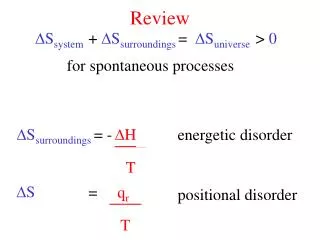
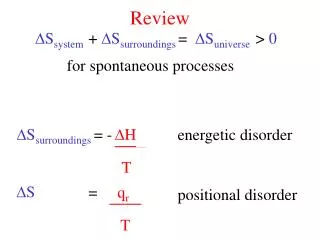
= -Hsys T = qr T Review Ssystem + Ssurroundings = Suniverse > 0 for spontaneous processes Ssurroundings energetic disorder Ssystem positional disorder
= -H T - Ssystem + Ssurroundings = Suniverse > 0 for spontaneous processes H2O(s) H2O(l) at 298 K spontaneous Ssurroundings H > 0 Ssurr < 0 Ssurr does not contribute to spontaneity
- + Ssystem + Ssurroundings = Suniverse for spontaneous processes H2O(s) H2O(l) at 298 K spontaneous solid liquid increasing disorder S > 0 S positional disorder Sdoes contribute to spontaneity
- + Ssystem + Ssurroundings = Suniverse H2O(s) H2O(l) S - H / T solid liquid endothermic positive negative At high T Suniv > 0 At low T Suniv < 0
+ Suniverse= Ssystem+ Ssurroundings > 0 N2O4(g) 2NO2(g) NO2 - brown, toxic gas N2O4- colorless gas Ssurr = -H /T H = HofN2O4 - 2 HofNO2 = (9.66) - (33.5) -58 kJ mol-1 2 = Ssurr 0 favors spontaneity >
- + Suniverse= Ssystem+ Ssurroundings > 0 2NO2(g) N2O4(g) S = Soproducts - Soreactants So (J mol-1 K-1) N2O4 NO2 304.18 239.95 S = -175.7 J/mol K = [304.18 - (239.95)] 2 non-spontaneous 2 mol gas 1 mol gas
- + Suniverse= Ssystem+ Ssurroundings > 0 2NO2(g) N2O4(g) S -H / T +58 kJ mol-1 T(K) -175.7 J mol-1 K-1 At high T At low T
G Free Energy Ssystem+ Ssurroundings = Suniverse> 0 > 0 - H T - T S = Suniverse H- TS = - TSuniverse < 0 G H - TS = H - TS G
G = H - TS spontaneous reaction G < 0 non-spontaneous reaction G > 0 equilibrium G = 0 maximum useful work G= wmax Gis an extensive State function Gof= 0 elements in standard states Gorxn = Gof products - Gof reactants
G= H - TS calculate Go for: CO2 (g) + 2H2O (l) CH4(g) + 2O2 (g) Gorxn = [Gof CO2 (g)+ ] 2 (Gof H2O (l)) - [ ] Gof CH4 (g) + 2(Gof O2 (g)) = - 819 kJ Gorxn =Horxn - TSorxn = [-892 kJ] - [ ] (298K) (-242 J/K) = -819 kJ
Rubber band Thermodynamics State 1 = relaxed State 2 = stretched go from State 1 to State 2 What is sign of Go + - What is sign of Ho What is sign of So Go= Ho- TSo - - +
Go = Ho - TSo Ho So Go +- always positive -+ always negative negative high T ++ positive low T -- negative low T positive high T
T So Equilibrium Go= Ho- TS Go= 0 phase changes chemical reactions Ho- Ho Ho = So TSo= 0 Hof prod - Hof react = T T = Ho ___________________________ Soprod - Soreact -58 kJ 2NO2 N2O4 = 331 K -175.7 J/K
Napoleon - 1812 tin buttons ΔHof (kJ/mol) So (J/mol K) white tin 0.0 51.55 grey tin -2.1 44.14 ΔHo = -2.1 - 0.0 = -2.1 kJ Snwhite Sngrey ΔSo = 44.14 - 51.55 = -7.4 J/mol K T = -2100 J = 283 K = 10oC -7.4 J/K ∆G298 = .105 kJ ∆G233 = -.376 kJ