Exploring Photosynthesis: Measuring Rates and Influencing Factors Using the Floating Disk Technique
This lab investigates the mechanisms of photosynthesis and the factors affecting its rate. Starting with leaf histology, we focus on the palisade and spongy mesophyll layers responsible for gas exchange. Utilizing the Floating Disk Technique, we analyze how light intensity impacts photosynthesis by observing the buoyancy of leaf disks in a CO2 solution. The experiment calculates ET50, the time for 50% of disks to float, allowing us to infer the relationship between light intensity and photosynthesis. We also address challenges in data interpretation to demonstrate direct correlations effectively.

Exploring Photosynthesis: Measuring Rates and Influencing Factors Using the Floating Disk Technique
E N D
Presentation Transcript
Background • How can we measure the rate of photosynthesis? • Reaction
Background Leaf histology: • Two cell layers that are responsible for photosynthesis • Palisade mesophyll: closely stacked • Spongy mesophyll: spacious, why? • Based the anatomy on this diagram, classify the type of plant. Justify your response
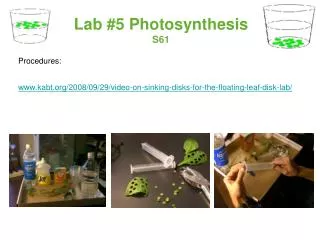
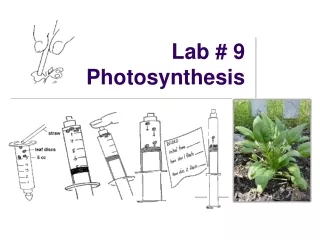
Floating Disk Technique: • Leaf disks float b/c of air spaces in the spongy mesophyll • When these spaces are infiltrated with a solution of CO2 , their density increases and they sink. • As photosynthesis occurs O2 is produced, which increases the buoyancy of the disk causing it to rise. • What does this technique measure in photosynthesis?
Procedure Materials
Data Collection and Analysis Raw data: We will count the number of floating leaf disks every 30 sec. until all disks are floating. Dependant Variable: ET50: The point at which the median (50%) number of disks are floating. • The ET50 of the example would be 11.5 min. Example experiment: How does light intensity affect the rate of photosynthesis?
Data Collection and Analysis Problem with the ET50: • The value goes down as the rate of photosynthesis goes up. (see example graph) • How can we mathematically solve this problem, to show a direct correlation.
Data Collection and Analysis Calculate the inverse of the ET50 or 1/ET50 Ex: ET50 for 200FT-C = 20 So 1/ET50 for 200FT-C = .05 When all data has been converted the proper direct relationship b/w light intensity and photosynthetic rate will be shown. (see graph)
What affects the rate of photosynthesis? Abiotic Biotic