Download
1 / 19
190 likes | 306 Views
This presentation introduces the concept of Universal Design in housing, tracing its evolution through key movements addressing changing demographics, barrier-free design, and significant legislation like the Fair Housing Amendments Act and the Americans with Disabilities Act (ADA). It discusses Universal Design principles aimed at improving usability for all individuals, including those with disabilities. Highlights include inclusive features of homes, benefits of adaptable design, and current policies that encourage the implementation of Universal Design principles in residential settings.

E N D
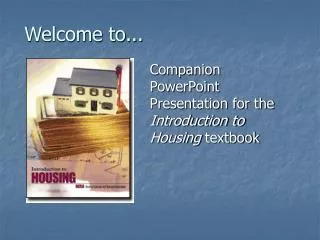
Welcome to... Companion PowerPoint Presentation for the Introduction to Housing textbook
Evolution It has developed over the years through several major movements: • Changing demographics of age & disability --Human lifespan has increased from 47 to 78 --More people are living with disability (53.9 million Americans have some form of disability)
Assistive technology Devices for personal use created specifically to enhance the abilities of people with disabilities • Barrier-free design Barrier removal specifically for the purpose of accommodating people with disabilities
Accessible design Built-in features in the environment to enable people to reach & use facilities • Fair Housing Amendments Act • Americans with Disabilities Act (ADA) None of these movements cover private single-family housing, although the design standards can be applied if wanted
Universal design is a philosophy that can be applied to housing • Basic questions about housing: Can visitors get in the house? Can visitors get through the doorways? Can visitors use the bathroom? • Easy-visiting home or Visitability
Premises of Universal Design • Varying ability is a common characteristic of being human • If a design works well for people with disabilities it works better for everyone • Usability & aesthetics are mutually compatible • Personal self-esteem, identity & well-being are affected by our ability to function in our physical surroundings
7 Principles of Universal Design • Equitable use The design is useful & marketable to people with diverse abilities --Multiple-height counters --Non-slip cutting surfaces --Wider interior doorways
Flexibility in use The design accommodates a wide range of individual preferences & abilities --Pull-out pantries & drawers --Railings down both sides of the stairs --Curbless shower
Simple & intuitive use Use of the design is easy to understand, regardless of the user’s experience, knowledge, language skills or current concentration level --Stepless entrance --Offset water controls in the shower & tub
Perceptible information The design communicates necessary information effectively to the user, regardless of ambient conditions or the user’s sensory abilities --Large dial on thermostat & telephone
Tolerance for error The design minimizes hazards & the adverse consequences of accidental or unintended actions --Crank or power-operated counter system --Texturized lever handles
Low physical effort The design can be used efficiently & comfortably & with a minimum of fatigue --Lever door handles --Light switches 44-48” --Electrical outlets 18” --Removable cabinet fronts --Front-loading washer & dryer
Size & space for approach & use Appropriate size & space is provided for approach, reach, manipulation & use regardless of user’s body size, posture or mobility --Entry door of 36” minimum width --Interior doors of 32” clearance --Hallway width of 42” minimum
Application: Bathroom • Hand-held adjustable shower head • Faucet controls off-set for easy reaching from outside tub • Anti-scald controls
Lowered mirror Non-slip flooring Removable base cabinet front Continuous flooring under lavatory Raised toilet
Benefits of Universal Design • Easy to use, convenient & safe • Emotionally supportive • Integrated into overall design of house • Cost effective
Current Status: Policy • Builder requirements for housing built with a public subsidy—requiring visitability features • Builder requirements for incentives for unsubsidized housing—Easy Living Home certificate program • Tax or fee incentives to the consumer—rebates or reductions in fees • Consumer awareness campaigns—consumers can select & pay for universal design features of their choice