Understanding Burn Types and Pediatric Assessment Protocols
This guide outlines the characteristics and management protocols for different types of burns, including superficial, partial thickness, and full thickness burns. Each type of burn varies in severity, healing time, and required interventions, ranging from spontaneous healing in superficial burns to surgical grafting for full thickness burns. Critical concurrent injuries like hypoxemia and CO poisoning are also addressed. An initial pediatric burn assessment emphasizes the importance of securing the scene, airway management, and necessary diagnostics to prioritize trauma management effectively.

Understanding Burn Types and Pediatric Assessment Protocols
E N D
Presentation Transcript
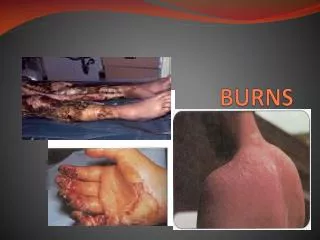
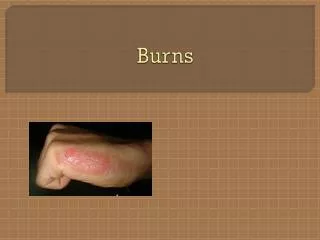
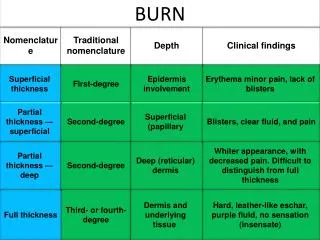
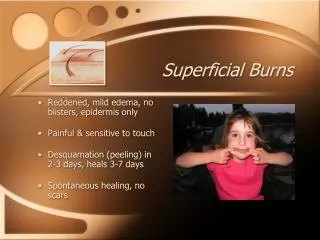
Superficial Burns • Reddened, mild edema, no blisters, epidermis only • Painful & sensitive to touch • Desquamation (peeling) in 2-3 days, heals 3-7 days • Spontaneous healing, no scars
Partial Thickness Burns • Superficial or deep, white or red skin, wet and weepy with blisters and edema • Involves epidermis and dermis; extremely painful • Heals in 2 to 6 weeks, may need debridement/grafting
Full Thickness Burns • Involves epidermis, dermis and underlying tissues or structures effected • Wound leathery, yellow or white; edema but no pain • Requires grafting and surgical intervention for repair
Concurrent Injuries • Hypoxemia/Hypercapnia • CO poisoning • Inhalation injuries • Blunt force trauma • Suspicious other injuries
Initial Pediatric Burn Assessment • Scene safe? Determine causative event & stop burning process • Aggressively manage airway; prepare for early RSI • Large bore IV access x 2 even through eschar; early IO? • Assess central AND peripheral pulses x 4, consider Doppler • Associated injuries? CO exposure? PMH? 12-lead for electrical? • Labs: ABGs, COHb, CBC, BMP or CMP, PO4, FSBS, UDS, ETOH • Diagnostics: CXR, CT, U/S? **TRAUMA MANAGEMENT TAKES PRIORITY**