Understanding the Basics of Biochemistry: Key Concepts in Lipids, Carbs, Nucleic Acids, and Proteins
This overview provides essential insights into fundamental biochemical concepts, including the structure and properties of lipids, carbohydrates, nucleic acids, and proteins. We explore the defining characteristics of these macromolecules, their components, and functional roles in biological systems. Key topics include the formation of bonds, the significance of dehydration synthesis and hydrolysis, and the role of enzymes in accelerating reactions. Understanding these principles is vital for grasping the complexities of biochemistry and its applications in various fields.

Understanding the Basics of Biochemistry: Key Concepts in Lipids, Carbs, Nucleic Acids, and Proteins
E N D
Presentation Transcript
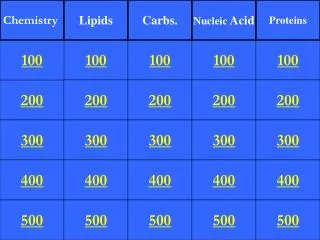
Chemistry Lipids Carbs. Nucleic Acid Proteins 100 100 100 100 100 200 200 200 200 200 300 300 300 300 300 400 400 400 400 400 500 500 500 500 500
A ________ bond is a weak bond that forms between two polar molecules.
It has 8 Fatty Acids which prevent enzymes from breaking it down.
What is the name of the bond formed between two monosaccharides?
Name a disaccharide and the two monosaccharides it is composed of.
T/F An Enzyme is a protein that speeds up a chemical reaction.
Temperature pH Concentration of enzyme and substrate Salt