Download
1 / 16
160 likes | 298 Views
The NCAR GIS Program, led by Jennifer Boehnert, focuses on integrating Earth and social sciences through spatial analysis and data interoperability. Emphasizing educational outreach and collaborative research, the program facilitates seamless integration of atmospheric and oceanographic data, thereby enhancing knowledge sharing among scientists, educators, and stakeholders. Key initiatives include the use of NetCDF formats in ESRI software, climate modeling, and developing interactive mapping applications to visualize weather impacts. The program serves diverse users in research, government, and education, driving forward climate change awareness and resource management.

E N D
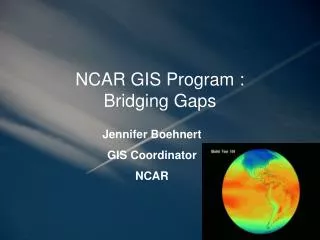
NCAR GIS Program :Bridging Gaps Jennifer Boehnert GIS Coordinator NCAR
Scope of work • Animation
Education, Training & User Support Data Integration & Distribution Research In GIS Technology Research Enabled by By GIS Building Community Goals and program elements • Conduct research integrating the Earth system and social sciences through spatial analysis and interoperability of georeferenced information; • Support the use of GIS as both an analysis, and an infrastructure tool in atmospheric research; • Improve usable science and knowledge sharing between science groups, educators and stakeholders.
2004 2005 2006 Atmospheric Data Model • Working dialog between ESRI and weather and climate community: • Five workshops in 2004-2008 • The goal is seamless integration of atmospheric and oceanographic data: • Observations • Products • Infrastructure Collaborators: NCAR, Unidata/UCAR, NWS. NOAA NCDC, University of Oklahoma, Pacific Marine Environment Lab, National Marine Fisheries Service, NASA Jet Propulsion Laboratory, ESRI, George Mason University Team Atmosphere (150 members) http://www.gis.ucar.edu/sig Data Modeling Group: http://swiki.ucar.edu/atmosgis
Satellite Images - Raster Radar - Polygons Observations Mobile Obs – Points Surface - Points Weather Events Atmospheric Boundaries Products Climate Variables Numerical Models Human Elements Infra Earth Surface The Thematic Layers
NetCDF in ArcGIS • Adopting NetCDF CF data format by ESRI GIS software • Since 2006 release of ArcGIS 9.2 NetCDF CF format can be read in GIS • Opens atmospheric and oceanographic data to millions of GIS users
Climate change on the map • Distributing CCSM IPCC projections (monthly averages) in a GIS format • GIS – a tool of many stakeholders (land and resource management) http://www.gisclimatechange.org
Who is using CCSM projections? Biomass potential Salmon conservation Resource management Climate change education Vegetation ecology Water resources Agriculture Vulnerability of population and ecosystems Human health Energy ~2500 users from 108 countries Users: Research; Education; Government; GIS; Environmental; Military and defense; Industry; Regional planning and economic development; Native American Tribes, Other…
From 155 km to 4.5 km grid cell Monthly temperature and precipitation projections for the continental U.S. Statistical downscaling method using PRISM (Parameter-elevation Regressions on Independent Slopes Model), dataset for derivation of a regression coefficients Statistical downscaling of CCSM runs 20C3M 1 Jan 1896 Tas celsius
New Products • Annual and seasonal averages • Available by fall • Anomaly – change • Present – 2030 • Present – 2050 • Present – 2099 • PPT –total precipitation • TAS – air temperature
Extreme Weather Application • Develop an interactive web mapping application which integrates weather forecast models with socio-economic and infrastructure data • Making weather models more useful and understandable for non-meteorologists • Communicate the impacts from extreme weather events
Visualization • Dynamically adds netCDF WRF Hurricane model through ArcGIS Server • Using ArcGIS Online free map as background • Symbolized based on hurricane wind scale (Saffir-Simpson Wind Scale) and accumulated rain.
Population Impacts • Find all people who will be effected by winds greater than 70 mph from 12:00 – 5:00 AM Sept 13th.
GIS Program THANK YOU boehnert@ucar.edu http://www.gis.ucar.edu