Download
1 / 30
300 likes | 409 Views
This chapter explores the fundamental concepts of energy, work, and simple machines. It defines work as the product of force and displacement, elaborates on kinetic energy, and introduces the work-kinetic energy theorem. Through practical problems, it illustrates how to calculate work done by forces at angles, the kinetic energy of moving objects, and the power required for various tasks. The chapter also details types of simple machines, mechanical advantage, and efficiency, providing a comprehensive overview of how these principles apply in real-world scenarios.

E N D
Chapter 10 Energy, Work, & Simple Machines
10.1 Energy & Work A force that causes a Displacement of an object does Work on that object.
Work is the product of the Magnitudes of the component Of a force along the direction And the displacement. W = Fd
Work has the dimensions of Force times length. Thus the units are N * m Or the Joule (J)
Work is only done when Components of a force are Parallel to a displacement. W = Fd (cos θ)
Problem... A tugboat pulls a ship with a force Of 5.00 X 10³ N. How much work Is done by the tugboat on the Ship if it moves 3.00 km? 1.50 X 10⁷ J
Problem... How much work is done on a Vacuum cleaner pulled 3.0 m by A force of 50 N at an angle of 30.0° above the horizontal? 130 J
Energy is The capacity to Do work or to Produce heat. Kinetic energy is the energy Of motion
The formula for kinetic energy Will be used often… KE = ½mv2
Problem... A 7 kg bowling ball moves at 3 m/s. How much kinetic energy does my Ball have? How fast must a Ping-pong ball (4.5) move to have The Same kinetic energy as the Other ball? 31.5 J 160 m/s
Problem... Calculate the KE of an 8.0 X 10⁴ kg airliner Flying at 600 km/h. 1.1 X 10⁹ J
The work-kinetic energy theorem Says that the net work done on An object is equal to the change In the kinetic energy of The object. The turns into a formula… W = ΔKE
PROBLEMS... A 105 g hockey puck is sliding Across the ice. Alec exerts a Constant 4.5 N force over a Distance of 0.15 m. How much Work is does Alec do on The puck? What is the change In the puck’s energy? 0.68 J
Power is the rate at which Energy is transferred. Or better stated as… W Δt P = Fv P = or
The SI unit for power is the Watt. A watt is defined as 1 J/s. Horsepower can also be used, And is equal to 746 W.
Problem... A 193 kg curtain needs to be raised 7.5m in as close to 5 s as possible. Three motors are available. The Power rating on each motor is 1 kW, 3.5 kW and 5.5 kW. Which Motor is best for the job. The 3.5 kW motor is best.
Problem... A 1000 kg elevator carries a Max load of 800 kg. A constant Frictional force of 4000N retards The motion. What minimum power Must the motor deliver to lift the Fully loaded elevator at a Constant speed of 3 m/s ? 66 kW
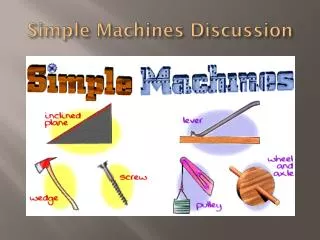
10.2 Machines There are 6 different types of Simple machines. A lever and Fulcrum An inclined plane Wheel and axle Wedge Pulley Screw
Inclined Plane Wheel & Axle
Screw Wedge
Lever Pulley
The point of a machine is to Make work easier. The amount that the work Gets easy is called Mechanical Advantage.
Fout Fin Output Force Input Force MA = = IMA is the Ideal Mechanical Advantage de = distance exerted de dr IMA = dr = distance Of the object
Efficiency is a measure of How well a machine works. Wout Win MA IMA eff = eff = A gasoline car is only about 30% efficient, where as an electric Car is about 90% efficient!!
Problem... A bike wheel has a radius of 35.6 cm and a gear with radius of 4 cm. When the chain is pulled 155N The rim moves 14 cm. the efficiency Is 95%. What is the IMA? What Is the MA? What is the resistance Force? How far was the chain pulled? 0.112 0.106 16.4 1.57