Bivariate Data Analysis: Summation and Sum of Squares Calculations
60 likes | 198 Views
This document outlines the process for calculating key summations and the sum of squares in bivariate data analysis using a dataset of tattoos (x) and piercings (y) recorded at a concert. It includes detailed steps for deriving the five essential summations: Σx, Σy, Σx², Σxy, and Σy², and the calculation of the sums of squares SS(x), SS(y), and SS(xy). Understanding these calculations is crucial for further statistical analysis and interpretations in the context of bivariate relationships.


Bivariate Data Analysis: Summation and Sum of Squares Calculations
E N D
Presentation Transcript
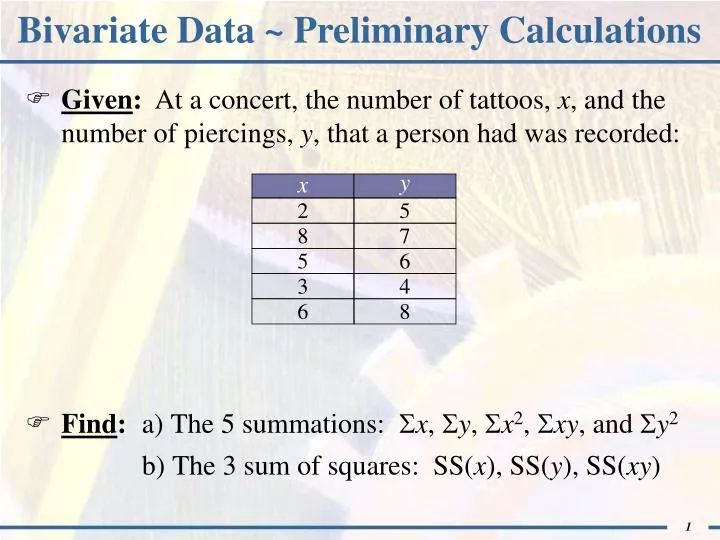
Bivariate Data ~ Preliminary Calculations x y 2 5 8 7 5 6 3 4 6 8 • Given: At a concert, the number of tattoos, x, and the number of piercings, y, that a person had was recorded: • Find: a)The 5 summations: x, y, x2, xy, and y2 b)The 3 sum of squares: SS(x), SS(y), SS(xy)
Finding Summations x y 2x5=10 52 = 25 22 = 4 2 5 8x7=56 72 = 49 82 = 64 8 7 2 5 5 2 25 5 2 62 = 36 5x6=30 52 = 25 5 6 8 8 7 7 8 7 87 3x4=12 42 = 16 32 = 9 3 4 5 6 6 5 5 56 6 6x8=48 82 = 64 62 = 36 6 8 3 4 4 4 3 34 3 68 6 8 6 6 8 8 • Use a table format to find the extensions for each pair of data and the5 summations: y2 xy x2 x = 24 y = 30 x2 = 138 y2 = 190 xy = 156 1. Find the x and y by totaling the x and y columns 2. For x2, multiply each x by itself and total the column 3. For y2, multiply each y by itself and total the column 4. For xy, multiply each pair of x and y values and total the column Note: Save these 5 summations for future formula work
The SS Formulas ~ Knowing the Parts (x)2 n x x2 - SS(x)= SS(x) x2 n • SS(x) is the “sum of squares for x”, a frequent factor in bivariate data analysis • x2 is the “sum of squared x’s”, the sum of all x-squared data • x is the “sum of x”, the sum of all x data • n is the “sample size”, the number of data
The SS Formulas ~ Knowing the Parts (y)2 n y y2 - SS(y)= SS(y) y2 n • SS(y) is the “sum of squares for y”, a frequent factor in bivariate data analysis • y2 is the “sum of squared y’s”, the sum of all y-squared data • y is the “sum of y”, the sum of all y data • n is the “sample size”, the number of data
The SS Formulas ~ Knowing the Parts (x)(y) n xy - SS(xy)= (x)(y) xy SS(xy) n • SS(xy) is the “sum of squares for xy”, a frequent factor in bivariate data analysis • xy is the “sum of xy”, the sum of all xy products • (x)(y) is the product of the two summations, x and y • n is the “sample size”, the number of data
Finding the 3 Sum of Squares x = 24 y = 30 n = 5 x = 24 y = 30 x2= 138 y2= 190 xy = 156 n = 5 n = 5 (24)2 5 24 30 5 (x)2 n SS(x) = x2 - = = 190 138 138 - 138 - 115.2 = 22.8 5 (30)2 5 (y)2 n (y)2 n y2 - SS(y) = y2 - = = 190 - 190 - 180 = 10 (24)(30) 5 (24)(30) (x)(y) n xy- SS(xy) = = = 156 156 - 190 - 180 = 10 5 (x)(y) n xy- (x)2 n x2 - • The summations from the table: x = 24 y = 30 x2= 138 y2= 190 xy = 156 n = 5 Note: Do not round the SS values, round after next calculation