Download
1 / 16
160 likes | 279 Views
This comprehensive overview explores various color models utilized in image processing, including RGB, HSV, HSL, and CMY/CMYK. It presents the fundamentals of color representation in 3D space, focusing on the additive model (RGB) for displays and the subtractive models (CMY/CMYK) used in printing. Learn how hues, saturation, and values are calculated, and discover the human eye's capabilities in color perception. By the end, you'll grasp the principles of color processing and how different models impact digital imagery.

E N D
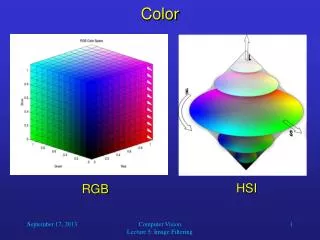
Color Standards • A pixel color is represented as a point in 3-D space. Axis may be labeled as independent colors such as R, G, B or may use other independent indicators such as Hue, lightness, saturation. • RBG, HSV, HSL are the most popular. 240-373 Image Processing
RGB • RGB (Red green blue) • For CRT display (TV, computer monitor) • Additive combination of r g and b 240-373 Image Processing
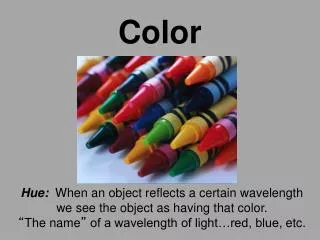
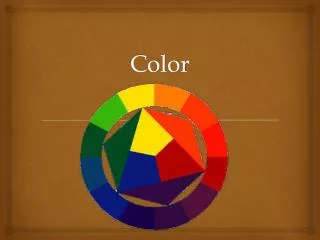
HSV • HSV (Hue Saturation Value) Hue is effectively a measure of the wavelength of the main color. It has a value between 0-255 (0-360o, Red = 0o, Green=120o and Blue=240o.) Hue can be calculated from RGB values as follows: Rh = R - min (R, G, B) Gh = G - min (R, G, B) Bh = B - min (R, G, B) At least on of these values is 0. Hue value is in between. 240-373 Image Processing
HSV For example if Rh = 0 Hue angle = (240xBh + 120xGh ) / (Bh + Gh) If two are zero, then hue is the angle corresponding to the third non-zero color. If three are zero, then there is no color hue. The monitor will display a gray level (between black and white). 240-373 Image Processing
Saturation • Saturation is the amount of pure hue in the final color If Saturation = 0, final color is without hue ( white light only) If Saturation = 255, no white light in final color Saturation = (max(R,G,B) - min (R,G,B)) / max(R,G,B) 240-373 Image Processing
Value • Value (brightness) is a measure of the intensity of the brightest component and given by Value = max(R,G,B) 240-373 Image Processing
The HSV Model 240-373 Image Processing
HSV Example Given R=100, G=200, B= 40, convert this RGB color model to HSV. Rh = 100 - min(100,200,40) = 60 Gh = 200 - min (100,200,40) = 160 Bh = 40 - min (100,200,40) = 0 H = (60*0 + 160*(120*256/360))/(60+160) 240-373 Image Processing
HSV Example (Continued) Saturation = (max(R,G,B) - min (R,G,B)) / max(R,G,B) = (max(100,200,40)-min(100,200,40))/ max(100,200,40) = (200-40)/200 = 0.8 = 80% Saturation = 80*256/100 = 204 Value = max(100,200,40) = 200 = 200*100/256 = 78% 240-373 Image Processing
HLS HLS (Hue Lightness Saturation) • Similar to HSV except that the hue angle start at Blue = 0o, and the model is double cone with a lightness axis going from L=0 (black) to L=1 (white) • For HLS, hue is calculated the same way as for HSV model except Blue = 0 and lightness and saturation are given by: • Lightness = (max(R,G,B) - min(R,G,B))/2 (max+min)/(max-min) if L <= 0.5 • Saturation = (max-min)/(2-max-min) otherwise 240-373 Image Processing
HLS 240-373 Image Processing
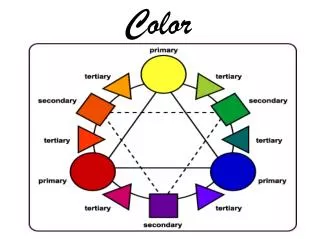
CMY & CMYK • CMY (Cyan Magenta Yellow) เป็นระบบสีที่พัฒนาขึ้นมาใช้สำหรับการพิมพ์ภาพสีโดยมีสีหลักคือสี Cyan Magenta และ Yellow ซึ่งเรียกว่า Subtractive primaries Color (สีแดง เขียวและน้ำเงิน เรียกว่า Additive primaries Color) ระบบสีแบบ CMY สามารถหาได้โดยการนำเอาสีในระบบ RGB ลบกับสีขาวดังนี้คือ 240-373 Image Processing
CMY & CMYK • ระบบสี CMY จะนำไปใช้สำหรับการพิมพ์ภาพสีแต่ยังไม่ดีเท่าที่ควรเนื่องจากไม่ยังไม่สามารถสร้างสีดำได้อย่างถูกต้อง ดังนั้นจึงมีการใช้ระบบ CMYK แทนโดย K แทนสีดำ 240-373 Image Processing
The Human Vision • Better than any camera yet developed • Eye has 2 classes of discrete light receptors; Cones and rods • 6-7 million cones, sensitive to bright light • >= 75 Million rods, sensitive to light intensity but not color • eye color perceptions 240-373 Image Processing
Color Additive • Problem with CRT 240-373 Image Processing