Download
1 / 5
50 likes | 202 Views
This chapter explores horizontal projectile motion, focusing on key factors influencing trajectories. It highlights that horizontal velocity remains constant while vertical velocity increases due to gravity. Both horizontal and vertical components function independently, sharing the same time interval. The relationship is visualized through a scenario with two balls, one rolling off a table and the other dropped simultaneously, showcasing their identical vertical positions at any given time. Practical applications include calculating the necessary speed for a diver to reach a safe distance from a cliff's base when jumping horizontally.

E N D
Horizontal Projectile Motion Chapter 3
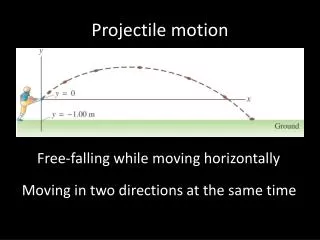
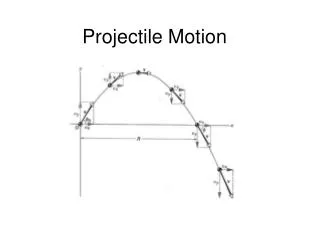
3-5 Projectile Motion • There are several key factors that should be considered when solving horizontal projectile motion problems: • The length of the horizontal vector shown in the in the figure is a clear indication that the velocity of the horizontal velocity “remains constant” for the entire path of its trajectory. • The length of the vertical velocity vector shown in the figure clearly indicates that from an initial velocity of zero, it constantly increases. • If we had some mechanism that would drop (say a ball) from rest at the very moment another similar ball rolled off the table shown, their velocities would be exactly the same (if we ignore any air resistance). • Both the horizontal and the vertical components of the velocity behave independently of each other. • Time is the consistently the same for both horizontal and vertical components.
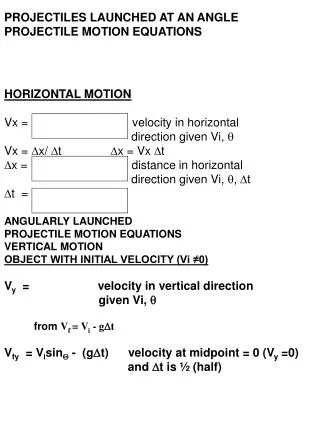
Horizontal Projectile Equations x - component y - component Equations Equations
3-5 Projectile Motion This photograph shows two balls that start to fall at the same time. The one on the right has an initial speed in the x-direction. It can be seen that vertical positions of the two balls are identical at identical times, while the horizontal position of the yellow ball increases linearly.
A diver practicing high dives from a cliff that has height of 35 m, above the lake below. She needs to run and push off horizontally so that she will reach a safe distance of 5.0 m from the base of the. (a) What minimum push off speed is necessary for her to splash down 5.0 m from the base of the cliff? (b) How long does it take her to reach the water below? Find the time first.