Overview of Beef Farming Practices in Godino Kebele, Ada’a Woreda, Ethiopia
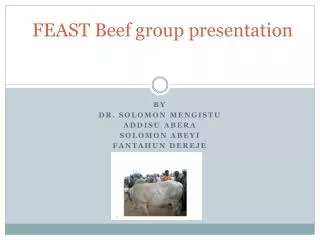
This presentation, delivered by Dr. Solomon Mengistu and colleagues, offers insights into the beef farming system in Godino Kebele, Ada’a, Ethiopia. It outlines the average farm size of 2 hectares, household dynamics, seasonal rainfall patterns, labor challenges, and prevailing agricultural inputs. The analysis reveals a significant reliance on irrigation, with 65% of households utilizing this method. Furthermore, it discusses livestock management, veterinary service availability, and challenges related to feed availability. The session concluded with farmer input on identified problems and potential solutions.

Overview of Beef Farming Practices in Godino Kebele, Ada’a Woreda, Ethiopia
E N D
Presentation Transcript
FEAST Beef group presentation By Dr. Solomon Mengistu AddisuAbera Solomon Abeyi FantahunDereje
Introduction Name of Kebele: Godino Name of Woreda:Ada’a Country: Ethiopia Number of participants: 5 (males=4, females=1) Date: March 14, 2012 Start time: 10:50 am Finishing time: 1:45 pm Total time taken = 2:55hrs
Description of the farming system • The average farm size = 2ha or 8 kert; [1ha= 4 kert] • The typical (or average) household size? 5 persons • The rainfall pattern vary over a years 0-5, where 5 = heavy rainfall levels and 0=no rainfall)? • Heavy RF = July and August • Medium RF = June and September • Small RF = April, May and October • No RF = November through March • There are two cropping seasons • Kiremet: June - July, August & September • Bega: October - May • Most of the area is suitable for irrigation • About 65% of the HH are using irrigation
Availability of labour There is shortage of labour due to seasonality of the work load When is it most required? During October to January which is the main cropping season Price of (daily-paid) labour : between 45 to 50 birr/ day Labour is highly demanded & very expensive during the cropping season Some Agricultural inputs: Credit & land are not readily available Other Agricultural inputs : urea, plastic sheeting, irrigation equipment's are not readily available in the local market so farmers are forced to search for them at big towns
Management of livestock Housing – separate housing, rarely in coral Feeding of cattle (stall fed, tethered, open grazing) – open grazing dominant for local & stall feeding for cross breed lactating. Feed processing (chopping, urea treatment, mixing etc.)- Combination of all. The veterinary services are there but the service is not adequate in most of the cases it is difficult to get drugs; the prophylactic method is not applicable. More over, the cost of treating animals is unaffordable by farmers. With regard to methods of livestock reproduction: AI & natural mating is being practiced. However, the availability of AI – service is very problematic; also the rate of repeat services – 2 to 3 times per conception. Farmers are resort to cross bred bull services
The summary of farmers’ view, identified problems & solutions
Summary of the observation: • Feed is the most critical problem affecting livestock production as farmers notified it,