Taking Notes
This lesson aims to enhance 6th graders' reading comprehension and note-taking skills, essential for post-secondary success. Students will explore effective strategies like the SQ3R method, which includes Surveying, Questioning, Reading, Reciting, and Reviewing. Additionally, they'll learn to use Q-Notes for organized note-taking. By engaging in discussions and practice exercises, students will develop approaches to reading smarter and taking meaningful notes that can be referenced for assignments and studying.

Taking Notes
E N D
Presentation Transcript
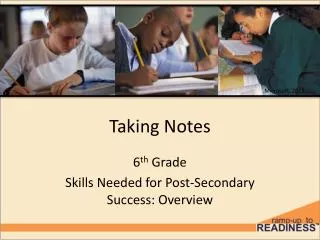
Taking Notes Microsoft, 2011 6th Grade Skills Needed for Post-Secondary Success: Overview
Discussion • Tell me about reading for your classes. • How often do you read something for class and get to the end of the page and realize you have no idea what you just read? • What strategies do you know to help you read smarter? • Tell me about taking notes in your classes. • How many of you look back at your notes after you take them? • How do you use your notes to study? • What note-taking techniques do you know?
Objective • The purpose of today's lesson is to help you read smarter and to help you take worthwhile notes Microsoft, 2011
Pre-test • What are the steps in SQ3R? • What do you record in the columns for Q-Notes? • How can you use SQ3R or Q-notes in your classes?
Reading Smarter: SQ3R • S = Survey • Q = Question • R = Read • R = Recite • R = Review Microsoft, 2011
SQ3R Practice • Directions: • Read the brief paragraph and complete the SQ3R notes on your own. • Pair up with a partner and discuss what you have written for each part of the SQ3R process.
Survey • First, I’ll look over, or survey, the article. • The headers and table tell me it’s about Oklahoma in the 1930’s, the dust bowl, farmers’ lives, and rainfall. • What else can I learn from a quick survey of the passage?
Question • To help me focus on each section, I’ll turn the headers into questions. • What was Oklahoma like in the 1930’s? • What was the dust bowl? • What was a farmer’s life like in Oklahoma in the 1930’s? • How much rainfall did they have in Oklahoma in the 1930’s? Was this normal? • What other questions did you have written down?
Read • Now I’ll read carefully to find the answers to my questions and record my answers.
Recite • I can recite, or say the most important ideas in each section in my own words. • In Oklahoma in the early 1930’s, a drought caused the soil to dry out and the wind blew the soil everywhere. They called this a dust bowl. Farmers could not farm because there was so little rain. In fact, there was about 4 inches less rain per year than in previous years.
Review • Were all my questions answered? I’ll review to find out. • All of my questions were answered. • Reviewing is an ongoing process, so I can keep these notes to review regularly. • These notes may be helpful for completing an assignment or studying for a quiz or test.
Q-Notes • Q-notes are two-column notes that can be used to study for quizzes and tests. • Divide your paper in half vertically • In the left column you write questions. • In the right column you write notes that answer the questions. • Q-Notes can be taken during class lectures, while reading, or to re-write notes you’ve already taken Questions Notes
Reading: Write Questions 1st Questions Notes
Take Notes as You Read Questions Notes
Lecture: Take Notes 1st Questions Notes
Write Questions Later Questions Notes
Q-Notes Practice • Pair up • Use the passage provided to practice writing Q-notes. • You may use your own paper or the paper provided • Fold the notes in half vertically • Quiz one another
Update Your Readiness Rubric • Self-Management • I take notes in class and when I read textbooks • Never, Rarely, Often, Never • Developing or Meeting
Post-test • What are the steps in SQ3R? • What do you record in the columns for Q-Notes? • How can you use SQ3R or Q-notes in your classes?
Review • The 5 Steps in SQ3R are: • Survey • Question • Read • Recite • Review • Q-Notes: • Record questions in the left column and notes in the right • How can you use SQ3R or Q-notes in your classes?
References • Burke, J. (2002). Tools for thought. Portsmouth, NH: Heinemann • Landsberger, J.F. (1996). SQ3R reading method.Retreived from http://www.studygs.net/texred2.htm • Microsoft Office Images. (2011). Retrieved from http://office.microsoft.com/en-us/images/