Understanding Fungi: Characteristics, Structure, and Classification
Fungi are multicellular eukaryotic heterotrophs that play crucial roles as decomposers, symbionts, and parasites in ecosystems. They have cell walls made of chitin and absorb nutrients by digesting food externally. Fungi can cause diseases in plants, humans, and other animals. Their structure includes hyphae that form a mycelium, with a large surface area for nutrient absorption. Fungi reproduce both asexually and sexually, with diverse classifications such as molds, sac fungi, and club fungi. This overview explores the fascinating world of fungi and their ecological significance.

Understanding Fungi: Characteristics, Structure, and Classification
E N D
Presentation Transcript
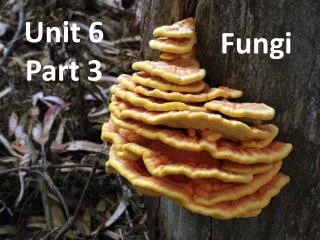
Fungi Unit 6 Part 3
Characteristics • Eukaryotic heterotrophs • Multicellular (except yeasts) • Cell wall • Made of chitin
Characteristics • Digest food outside of their bodies and then absorb it • Some absorb decaying matter in the soil (saprotrophic decomposers) • Some are symbiotic (lichen, plants) • Some are parasitic – absorb nutrients from host
Characteristics • Fungi as parasites: • Plant diseases (mildew, corn smut) • Human diseases (foot fungus, yeast infections) • Other animal diseases (Cordycepsfungus)
Structure & Function • Composed of thin filamentscalled Hyphae • Hyphae are tangled together in a thick mass called mycelium • Large surface area for absorbing nutrients
Structure & Function • Fruiting body – reproductive structure; grows from the mycelium in the soil • Can have many f.b.’s emerging from same mycelium
Structure & Function • Mycelium can live for many years • Over time…nutrients are depleted from soil around them…Why? • Result…
Structure & Function • Fairy Rings • New fungi sprout at edges of mycelium, forming rings.
Reproduction • Asexual: • Cells/hyphae break off + grown on own • Scattered spores (reproductive cell; grows into new org. through mitosis alone)
Reproduction • Sexual: • No “male/female” • Called “+” and “-” • Hyphae from + and – fuse together and produce a diploid zygote
Classification • Common Mold • Black bread mold • Sac Fungi • Largest group of fungi • Includes yeasts
Classification • Club Fungi • Reproductive structures look like clubs • Extremely diverse