
Advanced Design Methodologies for High Strength Steel in Pressure Equipment Manufacturing
E N D
Presentation Transcript
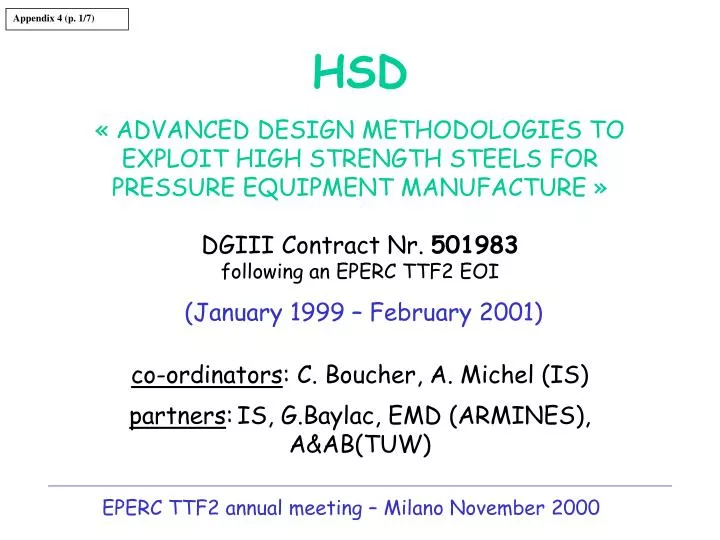
Appendix 4 (p. 1/7) HSD« ADVANCED DESIGN METHODOLOGIES TO EXPLOIT HIGH STRENGTH STEELS FOR PRESSURE EQUIPMENT MANUFACTURE »DGIII Contract Nr. 501983following an EPERC TTF2 EOI (January 1999 – February 2001)co-ordinators: C. Boucher, A. Michel (IS)partners:IS, G.Baylac, EMD (ARMINES), A&AB(TUW) EPERC TTF2 annual meeting – Milano November 2000
Appendix 4 (p. 2/7) Objectives • To demonstrate the present design codes may be adapted to allow for benefitting of the improved properties of fine grained TMCP and QT steels • To provide informations to DGIIIaiming at preparing recommendations for further work in support of standardisation EPERC TTF2 annual meeting – Milano November 2000
Appendix 4 (p. 3/7) Work programme • Enquiry on the use of HSS for PV manufacturing - literature survey and dissemination of a questionnaire to help to identify the needs • Design of prototypes (welded and non-welded PV) for the experimental validation of the design code deviation • DBA and DBF, fitness for purpose assessment • Experimental validation (fatigue tests and burst tests) • Reporting and Recommendations EPERC TTF2 annual meeting – Milano November 2000
Appendix 4 (p. 4/7) Enquiry results • 46 answers over 90 (60 companies) • Main difficulties faced by the manufacturerswere identified: • PWHT (new fabrication and repair) • HSS weld cracking • procurement (flanges and fitting) • etc. EPERC TTF2 annual meeting – Milano November 2000
Appendix 4 (p. 5/7) • Most relevant problems addressed: • PWHT: no PWHT after cold forming or for tempering and stress-relieving purpose • Procurement: use of standard normalised currently available flange and fitting • Prototypes for testing: • Sphere in TMCP steel – 460 MPa YS - 35 mm thick (as cold worked, no stress relieving) • Cylindrical shell in QT steel – 500 MPa YS - 25 mm thick (as cold worked, no temper) • Un-welded forged buffer vessel and screwed -in flat ends hydraulic accumulator in 34CrMo4 QT steel EPERC TTF2 annual meeting – Milano November 2000
Appendix 4 (p. 6/7) Welded PV testing A detailed testing protocol has been defined (the ECOPRESS project co-ordinator participated to the protocol definition) : • NDT • quasi-burst test • NDT • put artificial defects (spark-machining) in the most critical areas according to DBA • fatigue testing (Ds= 0 – Pd), 500 cycles minimum life • NDT EPERC TTF2 annual meeting – Milano November 2000
Appendix 4 (p. 7/7) Future work • Pressure test completion • Final report – recommendations to DGIII (by February 2001) • Co-ordination vs. ECOPRESS • Dissemination (EPERC, CEN, AFIAP conf. 2001…) EPERC TTF2 annual meeting – Milano November 2000