Understanding Types of Immunity: Innate and Acquired Defenses Against Pathogens
This chapter explores the two primary types of immunity: innate and acquired immunity. Innate immunity is present from birth and involves nonspecific defenses, including barrier defenses like skin and mucous membranes, as well as cellular responses like phagocytic white blood cells and natural killer cells. In contrast, acquired immunity develops after exposure to pathogens and offers specific responses facilitated by lymphocytes, including B cells and T cells. Learn how these systems work together to protect the body against infections and diseases.

Understanding Types of Immunity: Innate and Acquired Defenses Against Pathogens
E N D
Presentation Transcript
Immune System Chapter 43
2 Types of Immunity • 2 major kinds of defenses have evolved to counter threats of viruses, bacteria, & other pathogens • Innate Immunity • Present PRIOR to exposure • Effective from time of birth • Nonspecific • Acquired Immunity • Present only AFTER exposure • Highly specific
Innate Immunity • Barrier Defenses • Cellular Innate Defenses • Inflammatory Response • Natural Killer (NK) Cells
Barrier Defenses • Skin • Provides physical barrier to pathogens • Mucous membranes that cover epithelial linings and surfaces • Physical barrier as well • Secretions that lower skin pH • Lysozymes • Found in tears, sweat, & mucous secretions • Digests bacterial cell walls • Especially effective in eyes & Upper Resp. Tract (URT)
Cellular Innate Defenses 1. Phagocytic White Blood Cells (WBC) or Leukocytes • Neutrophils • Leukocytes that ingest + destroy microbes (phagocytosis) • Most abundant leukocyte • Chemotaxis attracts neutrophils to infected cells • http://en.wikipedia.org/wiki/File:S15-Competitive_Phagocytosis_Assay_in_Collagen.ogg
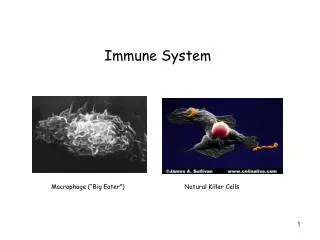
Cellular Innate Defenses (Page 2) • Eosinophils • Leukocytes that discharge hydrolytic enzymes when in close proximity to parasites (eukaryotic organisms) • Monocytes • Phagocytic leukocytes that develop into macrophages • Macrophages are giant phagocytic cells • Stimulate other immune responses Monocyte
Summary of Phagocytic WBCs • IF a microbe gets past the barriers, phagocytosis may occur • Ingestion of invading microbes by WBCs called phagocytes • Neutrophils • WBCs that ingest & destroy microbes by phagocytosis • Monocytes • Develop into macrophages (giant phagocytic cells) • Eosinophils • Leukocytes that defend against parasitic invaders by secreting hydrolytic enzymes on them
Cellular Innate Defenses (Page 3) 2. Antimicrobial Proteins • Interferon • Innate defense against viral infections • Alter cells adjacent to viral-infected cells to produce substances that inhibit viral replication • Complement System • Leads to the lysis of invading cells • Also play a role in inflammation & acquired defense
Inflammatory Response • Tissue damage due to physical injury (trauma) or pathogen entry • This triggers the release of chemical signals which result in an inflammatory response • Histamine – chemical released in response to injury • Stored in Mast Cells (mastocyte) (found in connective tissues) • Trigger the dilation and permeability of nearby capillaries • Delivers clotting agents & phagocytic cells to the injured area • Fever & septic shock
http://video.google.com/videosearch?sourceid=chrome&q=inflammatory+response&um=1&ie=UTF-8&ei=OweUS6ChJoS0tgfrhsTUCg&sa=X&oi=video_result_group&ct=title&resnum=10&ved=0CDAQqwQwCQ#http://video.google.com/videosearch?sourceid=chrome&q=inflammatory+response&um=1&ie=UTF-8&ei=OweUS6ChJoS0tgfrhsTUCg&sa=X&oi=video_result_group&ct=title&resnum=10&ved=0CDAQqwQwCQ# • Videos 2 & 4
Chemical signals (like histamines) released by macrophages & mast cells at the injury site • Nearby capillaries dilate & become more permeable • Clotting begins • Chemokines attract more phagocytic cells from the blood to the injury site • Neutrophils & macrophages phagocytose pathogens & cell debris
-itis = Inflammatory Response • Appendix appendicitis • Pancreas pancreatitis • Meninges meningitis • Liver hepatitis • Joints arthritis • Septic shock – overwhelming inflammatory response (systemic) • High fever + Low BP • Most common cause of death in critical care units (CCUs)
Natural Killer (NK) Cells • 4th type of innate immunity • Patrol the body and attack virus-infected body cells • Also attack cancerous cells • Recognize & remove diseased cells • NK releases chemicals that lead to apoptosis • Apoptosis = programmed cell death
Acquired Immunity • Lymphocytes provide SPECIFIC defenses • 2nd line of defense • 2 Types of Lymphocytes (NOT Leukocytes (WBCs)) • B Lymphocytes – B Cells • Proliferate in Bone marrow • Produce antibodies • T Lymphocytes- T Cells • Mature in the Thymus • Helper T-cells (CD4) or Cytotoxic T-cells (CD8)
Acquired Immunity (Page 2) • Lymphocytes circulate through the blood and lymph • Lymphocytes are concentrated in the spleen, lymph nodes, & other lymphatic tissues • Recognize antigens by antigen-specific receptors on their plasma membranes • Antigen – any foreign molecule that elicits a response by lymphocytes • A lymphocyte may have 100,000 receptors, but all of them are specific for only 1 epitope • Epitope – small accessible part of an antigen
Antibodies • Produced by B-cells • When secreted, the antibodies are called immunoglobulins • Part of the humoral immune response • Specific to a given antigen
Activation • Either B- or T-cells can be activated • Occurs when an antigen binds to a B or T cell • Activation leads to each lymphocyte forming 2 types of clonal cells • Clonal cells are all specific to the antigen • 1. Effector cells – combat the antigen • 2. Memory cells – Long-lived & bear receptors for the same antigen • Allows for a quick immune response in the FUTURE
How do B-cells and T-cells Differ? • B-cell receptors bind intact antigens • T-cells bind antigens presented to them by antigen-presenting cells (APC) • B-cell or T-cell responds to only ONE antigen (Specific)
MHC Proteins • Immune system’s way of recognizing “self” cells • Major Histocompatibility Complex molecules (MHC) • Every individual is different in their MHC proteins • MHC proteins bind to an antigen and bring it to the cell surface • Called antigen presentation
MHC Proteins (Page 2) • Two types of MHC proteins • Class 1 MHC – All cells but RBCs • Recognized by cytotoxic T-cells (CD8) • Class 2 MHC – B cells & macrophages • The B cells and macrophages that use Class 2 MHC proteins are called APC (Antigen-presenting cells) • Associated with Helper T-cells (CD4)
Immune Response Types • Primary Immune Response • First exposure to an antigen • Lymphocyte activation • Secondary Immune Response • Antigen in encountered again • Rapid & stronger response
Acquired Immunity • Humoral Immune Response • Involves the activation and clonal selection of effector B cells • B cells produce antibodies that circulate in the blood • Helper T-cells are also involved in the activation of B cells • Cell-Mediated Immune Response • Activation and clonal selection of cytotoxic T cells • Cytotoxic T cells identify & destroy infected cells
Notes on Acquired Immunity • Helper T cell (CD4) • Aids in BOTH responses • Class II MHC on an APC activates the Helper T cells • Secrete cytokines which stimulate BOTH Cytotoxic-T-cells and B-cells • CD4 protein holds helper T-cell to class II MHC • Cytotoxic T cell (CD8) • Binds to Class I MHC • Bound together by the CD8 protein
Comparision • B-cells - produce antibodies (provides humoral immunity) • B-cells produce memory cells and plasma cells • Plasma cells secrete antibodies in huge numbers • Antibodies circulate in blood, then bind & destroy antigen • Cytotoxic T-cells – destroy infected body cells • Helper T-cells – activate both B and T cells
Antibody Actions • Neutralization – Antibodies bind to pathogen’s surface proteins • Prevents pathogen from entering & infecting cells • Opsonization • Results in increased phagocytosis of the antigen • Lysis • Caused by activation of the complement system
Immunities • Active Immunity • Body comes in contact with antigens • Actively produces antibodies in response to antigen presentation • Naturally developed immunity after an infection • Vaccination or immunization • Passive Immunity • Individual receives antibodies • Placental transmission of immunoglobulins (Antibodies)
Show vaccination video • Vaccination Video
Erythrocyte (RBC) Antigens • A, B, AB, or none • Determined by antigen presence on RBC surface • IF non-self, antibodies will form on the foreign antigens • Destroy transfused RBCs
Immune System Pathologies • Lupus, Rheumatoid arthritis, and MS • Immune system fails to recognize body cells • Since these cells are detected as foreign, immune system attacks the body’s own healthy cells • HIV – attacks CD4 cells or Helper-T-cells • Allergies – body over-responds to an allergen • IgE – immunoglobulin E • Histamine & other mediators cause vasodilation and other symptoms • Mast cells mediate the histamine production