
SINX-C
E N D
Presentation Transcript
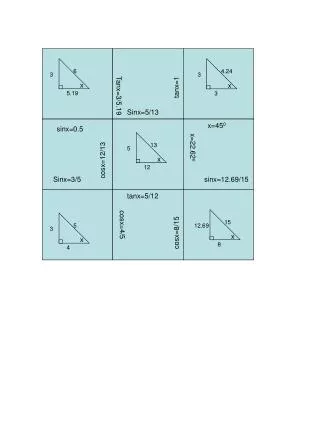
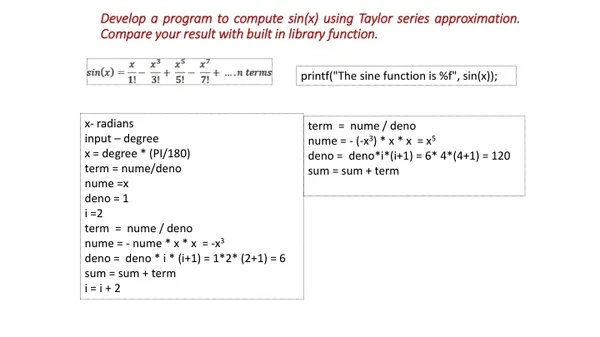
Develop Develop a a program Compare Compare your your result program to to compute result with with built compute sin(x) built in in library sin(x) using library function function. . using Taylor Taylor series series approximation approximation. . printf("The sine function is %f", sin(x)); x- radians input – degree x = degree * (PI/180) term = nume/deno nume =x deno = 1 i =2 term = nume / deno nume = - nume * x * x = -x3 deno = deno * i * (i+1) = 1*2* (2+1) = 6 sum = sum + term i = i + 2 term = nume / deno nume = - (-x3) * x * x = x5 deno = deno*i*(i+1) = 6* 4*(4+1) = 120 sum = sum + term
Develop Develop a a program Compare Compare your your result program to to compute result with with built compute sin(x) built in in library sin(x) using library function function. . using Taylor Taylor series series approximation approximation. . #include<stdio.h> #include<stdio.h> #include<math.h> #define PI 3.142 void main() { int i, degree; float x, sum=0, term, nume, deno; printf("Enter the value of degree"); scanf("%d", °ree); x = degree * (PI/180); //converting degree into radian nume = x; deno = 1; i=2;
Develop Develop a a program Compare Compare your your result program to to compute result with with built compute sin(x) built in in library sin(x) using library function function. . using Taylor Taylor series series approximation approximation. . do { //calculating the sine value. term = nume/deno; nume = -nume*x*x; deno = deno*i*(i+1); sum=sum+term; i=i+2; } while (fabs(term) >= 0.00001); // Accurate to 4 digits printf("The sine of %d is %.3f\n", degree, sum); printf("The sine function of %d is %.3f", degree, sin(x)); }