Antenna Positioning Systems Enabling Precise RF Testing
Unlock the full potential of your RF testing with advanced antenna positioning systems. Designed for precision and repeatability, these systems ensure accurate antenna alignment and seamless integration into automated test setupsu2014critical for reliable performance validation in 5G, satellite, radar, and wireless applications. Elevate your test accuracy with smart positioning solutions.


Antenna Positioning Systems Enabling Precise RF Testing
E N D
Presentation Transcript
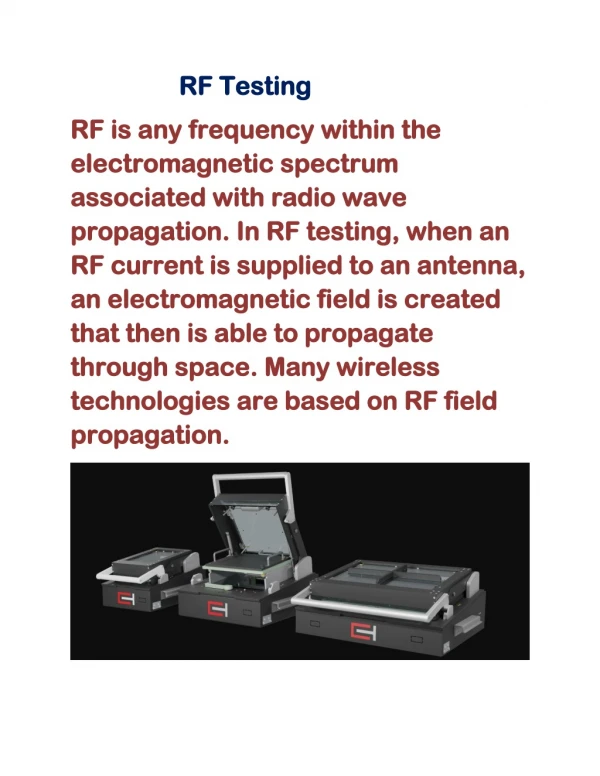
Antenna Positioning Systems: Enabling Precise RF Testing An antenna positioning system is essential for accurately evaluating the performance of wireless devices. These systems help ensure devices meet international testing standards by precisely controlling antenna direction during measurements. They are widely used in test environments for technologies like 5G, radar, and satellite communications to improve accuracy and reliability.
What are Antenna Positioning Systems? Positioner Controller Precise electromechanical movement Software-driven automated control RF Cables Rotary Joints Transmit high-frequency signals Maintain RF signal integrity These electro-mechanical systems precisely orient a Device Under Test (DUT). Key components include the positioner, controller, rotary joints, and RF cables. They enable 3D pattern measurements of radiated power and sensitivity, essential for Over-The-Air (OTA) testing in anechoic chambers.
Why are they Crucial for RF Testing? Characterisation Measures antenna patterns, gain, and efficiency, including EIRP, TRP, and TIS. Compliance Ensures devices meet regulatory standards such as CE, FCC, and ETSI guidelines. Antenna positioning systems are crucial for antenna optimisation, identifying optimal placement and design. They achieve high repeatability of 0.005 degrees and accuracy of 0.01-0.05 degrees, ensuring consistent and precise measurement results.
Type 1: Azimuth-over- Elevation (Az/El) Positioners Azimuth-over-Elevation (Az/El) positioners are the most common type for antenna pattern measurements. They offer 360° azimuth rotation and typically ±90° elevation. Ideal for far-field and compact range systems, they handle payloads from 5kg to 200kg. These are widely used for testing cellular devices like 5G NR, LTE, Wi-Fi, and Bluetooth.
Type 2: Spherical/Full 3D Positioners Full 360° Rotation Comprehensive Coverage All axes: azimuth, elevation, roll. Spherical pattern measurements. High Rigidity Complex Arrays Repeatable spherical scanning. Supports advanced beamforming. Spherical positioners offer full 360° rotation across all axes, essential for comprehensive spherical measurements. They support complex antenna arrays and beamforming analysis with high precision and rigidity. These systems are critical for satellite communication antennas and advanced radar systems.
Type 3: Robotic Antenna Positioners Robotic antenna positioners use multi-axis robotic arms for highly flexible DUT positioning. They provide exceptional versatility for complex test scenarios and large DUTs. Their integration with industrial robotics ensures high payload capacity and speed. These systems are applied in automotive radar testing, aerospace, and large array antenna characterisation.
Conclusion: Advancing Wireless Performance Antenna positioning systems are indispensable for modern RF testing. They enable precise characterisation and compliance verification of wireless devices. Continued innovation in robotics and control systems enhances test capabilities. These systems are critical for accelerating the development of 5G, IoT, and future wireless technologies. www.orbissystems.eu