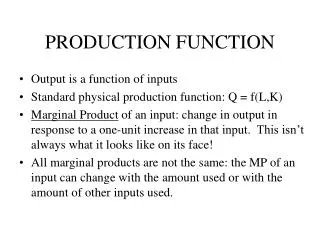
PRODUCTION FUNCTION
The production function explains a basic technological relationship between scarce resources or inputs and output. This paper offers a brief overview of the historical significance and operational role of the production function in business and economics. The origin and development of this function over time is initially explored. Studies show that the manufacturing enterprise aims to use a number of concepts in order to efficiently conduct their operations. However, due to the complexity of these concepts there are many shortcomings that affect their implementation. Therefore, the purpose of this paper is to explore why manufacturing and production concepts didnu2019t succeed to lead to a more efficient engineering enterprise. Based on the paper's qualitative findings supported by authorities evidence or logic essentially it is argued that the various manufacturing concepts are interdependent and so should not be viewed in isolation but that they should be viewed as components of a broad framework that unite them and that finally leads to a more efficient manufacturing enterprise


PRODUCTION FUNCTION
E N D
Presentation Transcript
Production Concept Production Concepts Complexity in Relation with Business Economics Submitting to – INESE SPICA Submitted By – Naveen Nelson Group -0100z
PRODUCTION CONCEPTS PRODUCTION CONCEPTS COMPLEXITY IN RELATION WITH BUSINESS ECONOMICS
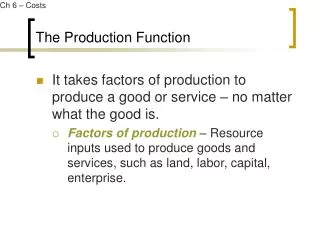
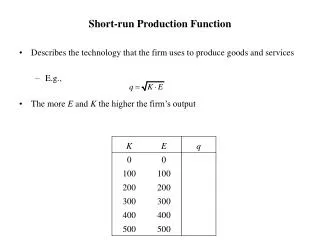
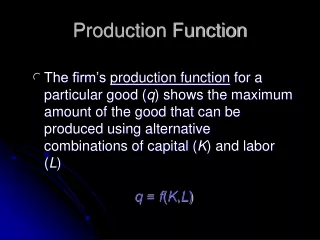
THE PRODUCTION FUNCTION FOR A SINGLE PRODUCT The production function is a purely technical relation which connects factor inputs and outputs. It describes the laws of proportion, that is, the transformation of factor inputs into products at any particular time period. Method of production is a combination of factor inputs required for the production of one unit of output.
ISOQUANT AND ITS TYPES An Isoquant is the locus of all the technically efficient methods(or all the combinations of factors of production) for producing a given level of output. Quisque lacinia, nisl eu tempor pulvinar, neque mi pellentesque dui, id lacinia velit elit a mi. In sagittis turpis ultricies velit mollis, in mattis elit viverra. DIFFERENT SHAPES OF ISOQUANT:
VARIOUS CONCEPTS USED IN THE THEORY OF PRODUCTION. MARGINAL PRODUCTIVITY OF A FACTOR OF PRODUCTION: IT IS DEFINED AS THE CHANGE IN OUTPUT RESULTING FROM A VERY SMALL CHANGE OF THIS FACTOR, KEEPING ALL OTHER FACTORS CONSTANT. MARGINAL RATE OF TECHNICAL SUBSTITUTION: THE SLOPE OF ISOQUANT IS CALLED MRTS AND IS EQUAL TO THE RATIO OF MARGINAL PRODUCTS OF THE FACTORS. ELASTICITY OF SUBSTITUTION: FACTOR INTENSITY: IT IS MEASURED BY THE SLOPE OF THE LINE THROUGH THE ORIGIN REPRESENTING THE PARTICULAR PROCESS THE EFFICIENCY OF PRODUCTION: THE RETURNS TO SCALE. IT REFERS TO THE EFFECTS OF SCALE RELATIONSHIPS. IT CAN BE CONSTANT RETURNS TO SCALE, INCREASING RETURNS TO SCALE AND DECREASING RETURNS TO SCALE. HOMOGENOUS FUNCTION: IF EACH OF THE FACTOR INPUTS IS MULTIPLIED BY K, THEN K IS COMPLETELY FACTORED OUT OF THE FUNCTION. LETS MAKE THESE CONCEPTS CLEAR BY AN EXAMPLE OF COBB –DOUGLAS PRODUCTION FUNCTION.
" VIVAMUS CURSUS DUI TINCIDUNT, IMPERDIET SEM NEC FAUCIBUS SEM SUSPENDISSE POTENTI. " LINEAR PRODUCTION FUNCTION FIXED PROPORTIONS PRODUCTION FUNCTION COBB-DOUGLAS PRODUCTION FUNCTION CONSTANT ELASTICITY OF SUBSTITUTION PRODUCTION FUNCTION VARIABLE ELASTICITY OF SUBSTITUTION PRODUCTION FUNCTION AGGREGATE PRODUCTION FUNCTION JOINT PRODUCTION FUNCTION NOTE: IN THE NEXT SLIDE, THE CONCEPTS ARE CLEARED WITH THE HELP OF COBB- DOUGLAS PRODUCTION FUNCTION ONLY .
6 COBB- DOUGLAS PRODUCTION FUNCTION This production function was developed and tested against statistical evidence by Charles Cobb and Paul Douglas during The mathematical form of CD production function is: X=b0Lb1Kb2 where X is the output, L is the labour and K is the capital. Now lets explain the concepts mentioned in the 4th slide with the help of this production function, 1.The marginal product of factors The marginal product of labour: MPL = ∂X/∂L= b1 b0 Lb1-1 Kb2 = b1 (b0 Lb1Kb2)L-1 = b1
THE MARGINAL RATE OF TECHNICAL SUBSTITUTION THUS, THE MARGINAL PRODUCT OF LABOUR IS EQUAL TO MPL = B1(APL) SIMILARLY, THE MARGINAL PRODUCT OF CAPITAL IS EQUAL TO MPK = B2(APK)
" VIVAMUS CURSUS DUI TINCIDUNT, IMPERDIET SEM NEC FAUCIBUS SEM SUSPENDISSE POTENTI. " FACTOR INTENSITY :IN CD PRODUCTION FUNCTION, FACTOR INTENSITY IS MEASURED BY THE RATIO B1/B2. THE HIGHER THIS RATIO THE MORE LABOUR INTENSIVE THE TECHNIQUE. SIMILARLY, THE LOWER THE RATIO ,THE MORE CAPITAL INTENSIVE THE TECHNIQUE . 5.THE EFFICIENCY OF PRODUCTION: IT IS MEASURED BY B0. THE MORE EFFICIENT FIRM WILL HAVE A LARGER B0 THAN THE LESS EFFICIENT ONE IF THE TWO FIRMS HAVE THE SAME K,L, B1 AND B2 AND STILL PRODUCE DIFFERENT QUANTITIES OF OUTPUT.
THE The returns to scale in Cobb douglas PF is given by the sum of the coefficients(b1+ b2). If (b1+ b2)=1, it is constant returns to scale If (b1+ b2)>1, it is increasing returns to scale If (b1+ b2)<1, it is decreasing returns to scale 7. This production function is homogenous of degree 1. RETURNS TO SCALE
CONSTANT ELASTICITY OF SUBSTITUTION PRODUCTION FUNCTION A PRODUCTION FUNCTION WHICH BELONGS TO THE CES CLASS HAS TWO MAIN CHARACTERISTICS IT IS HOMOGENOUS OF DEGREE 1 AND IT HAS A CONSTANT ELASTICITY OF SUBSTITUTION PARAMETER
It is important to note that ϒ shifts the production function and is called the efficiency parameter, δ allows K and L to vary and is called distribution parameter and ρ is the substitution parameter. In case of higher the elasticity of production function, ρ is equal to its maximum value of 1. It can be shown that for the constant returns to scale case σ = 1/1- ρ, so that CES function incorporates the linear, fixed- proportions and Cobb- Douglas functions as special cases( for ρ=1,-infinity and 0 respectively).
OTHER PRODUCTION FUNCTIONS LINEAR PRODUCTION FUNCTION: IT EXHIBITS CONSTANT RETURNS TO SCALE AND THE SHAPE OF ISOQUANTS ARE PARALLEL STRAIGHT LINES. FIXED PROPORTIONS PRODUCTION FUNCTION: THE ISOQUANTS ARE L SHAPED IN THIS CASE. VARIABLE ELASTICITY OF SUBSTITUTION PRODUCTION FUNCTION: SUCH PRODUCTION FUNCTIONS HAVE VARIABLE ELASTICITY OF SUBSTITUTION PARAMETER ALONG THE INTERCEPT TERM OF UNITY.
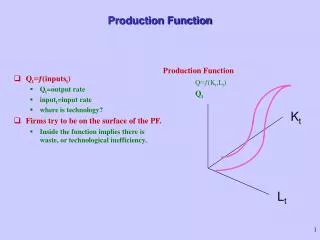
AGGREGATE PRODUCTION FUNCTION Aggregate Production Function: This is used in Growth Accounting. Its functional form is Y=F(A,K,L) where Y is total output, K is the stock of the capital and L is the labour force and A is the “Catch all” factor for technology, role of institutions and other relevant forces which measures how productively capital and labour are used in production
JOINT PRODUCTION FUNCTION A PRODUCTION FUNCTION WHICH SHOWS TWO OR MORE OUTPUTS PRODUCED FROM A SINGLE INPUT IS A JOINT PRODUCTION FUNCTION. FOR EG: SHEEP RAISING IS A CLASSIC EXAMPLE. SHEEP IS THE ONLY INPUT BUT ITS TWO OUTPUTS ARE WOOL AND MUTTON.
KORBI MOLESIE NISLAC 1 Perfect divisibility of both inputs and outputs 2 Limited substitution of one factor for another 3 Constant technology 4 Inelastic supply of fixed factors in the short run
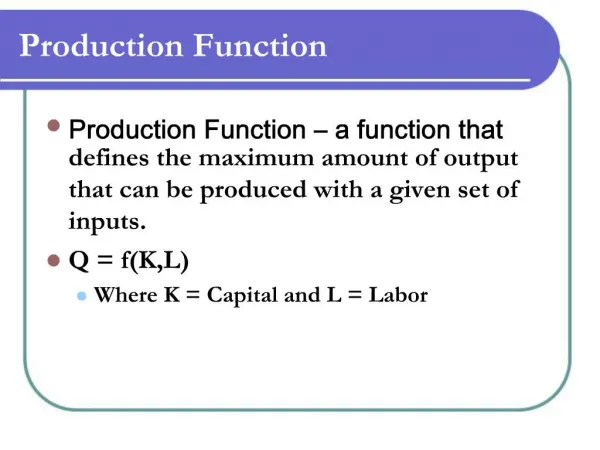
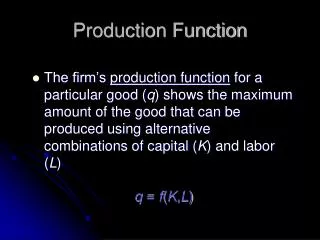
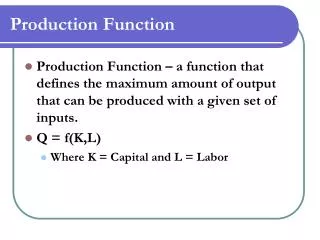
SUMMARY A PRODUCTION FUNCTION SPECIFIES THE MAXIMUM OUTPUT THAT CAN BE PRODUCED WITH A GIVEN SET OF INPUTS. IN ORDER TO ACHIEVE MAXIMUM PROFITS THE PRODUCTION MANAGER HAS TO USE OPTIMUM INPUT-OUTPUT COMBINATION FOR A GIVEN COST. IN THIS UNIT, WE HAVE SHOWN HOW A PRODUCTION MANAGER MINIMIZES THE COST FOR A GIVEN OUTPUT IN ORDER TO MAXIMIZE THE PROFIT. ALSO, WE HAVE SHOWN HOW TO MAXIMIZE THE OUTPUT AT A GIVEN LEVEL OF COST.