
PPM 1ott14
E N D
Presentation Transcript
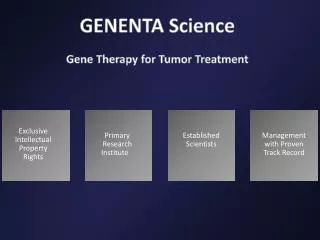
GENENTA Science • Gene Therapy for Tumor Treatment • Exclusive Intellectual Property Rights • Primary Research Institute • Established Scientists • Management with Proven Track Record
Business Purpose Development of gene therapy protocols for tumor treatment GENENTA Science develops a novel therapy based on gene transfer into autologous hematopoietic stem cells (HSCs) to target the interferon-α expression to tumor-infiltrating monocytes/macrophages. An HIV-derived and genetically disabled viral vector - Lentivirus - delivers the gene into the HSCs. Interferon-α is a protein that exhibits a powerful anti-tumor activity. However, the clinical use of interferon as drug has been limited by its high toxicity. Thanks to GENENTA Science’s innovative therapy, using a combination of transcriptional and microRNA-mediated control, tumor-infiltrating monocytes/macrophages become capable to selectively express interferon-α limited to the tumor area, thus reducing its toxicity. Based on these mechanisms, a population of tumor-infiltrating monocytes/macrophages, TIE2-expressing monocytes (TEMs) with proangiogenic activity, are "armed" with a specific drug. Tie2-IFNα-126T/130T into HS/PC 02
key Milestones (1) • 1996, Luigi Naldini (Salk Institute, La Jolla, CA) describes HIV-derived Lentivirus as efficient vehicles to deliver genes in vivo into cells [Science 1996, 272: 263-267] • 2002, firstclinical trial by using gene therapy to successfully treat two children affected by Ada-Scid(Italy, Telethon) • 2003, Naldini’slaboratory describes TEMs as a specific population of tumor-infiltrating monocytes[De Palma et al., Nat Med 2003, 9:789-95; 332 cit; Cancer Cell 2005;8:211-26; 502 cit] • 2006-2007, microRNAcan be broadly exploited to stringently regulate lentiviral vector expression according to tissue, lineage and differentiation state [Brown et al., Nat Med. 2006, 12: 585-91, 198 cit; Brown & Gentner et al., Nat Biotech, 2007, 25:1457-1467, 197 cit] • 2009, first clinical trial by using Lentivirus to successfully treat an inherited disease, Adrenoleukodystrophy(ALD) [Naldini, Science November 6, 2009 DOI: 10.1126/science.1181937] microRNA (miRNA) small noncoding RNA that regulates gene expression 03
key Milestones (2) • 2010, GSK (Glaxo SmithKline), OSR and TelethonAlliance to develop experimental gene therapy for rare diseases (i.e. severe combined immune deficiency) • 2011, First In Human gene therapy lentiviral-based studyon Wiskott Aldrich (WAS) and Metachromatic LeukoDystrophy (MLD) • 2013, Cure of six children for WAS and MLD, clinical proof of concept, safety and efficacy [Science 2013, doi: 10.1126/science.1233158; Science 2013, doi: 10.1126/science.1233151] • 2014, January 1. Genetic engineering of hematopoiesis for targeted interferon-α (IFN-α)delivery inhibits cancer[Naldini, Gentner, ScienceTM 2014, doi: 10.1126/scitranslmed.3006353] • 2014, July 24. GENENTA Science incorporation: Gene Therapy for Tumor Treatment 04
tiget The San Raffaele-Telethon Institute for Gene Therapy (TIGET) is a joint-venture between the San Raffaele Hospital and the Telethon Foundation. TIGET performs innovative research on gene transfer and cell transplantation,and translates the results into successful clinical application for genetic diseases. Telethon Foundation is a major Italian charity. Telethon goal is to fulfill the promise of curing rare genetic diseases by raising funds for excellent biomedical research. San Raffaele Hospital (OSR) is the Italian leader in scientific research. • TIGET has been conducted several successful ex-vivo gene therapy clinical trials aimed at treating patients with rare genetic diseases • These therapies should became the first ex-vivo gene therapies registered for the market (through the TIGET-GSK Alliance) • GENENTA Science stems from the research developed in the TIGET laboratories 05
patents Exclusive IPRs Portfolio microRNA Regulated Vectors (therapeutic use) (2005): WO2007000668 Gene Vector, microRNA126/microRNA130 (2009): WO2010125471 Tie2-expr. proangiogenic monocytes TEMs (2006): US7833789 Improved HSCP manipulation (2013): UK appl. No. 1318830.5 This patent portfolio is one of the most relevant and complete IPRs worldwide that combines transcriptional and microRNA-mediated control strategy for the therapeutic use of gene-based medicine. This portfolio is also backed by proprietary know-how on manufacturing and clinical application of lentiviral vectors for gene therapy which should ensure prompt and effective clinical translation. OSR has granted to Genenta Science a perpetual,exclusive,worldwidelicense of the patents, with the right to grant sublicenses, to conduct the research, to develop, make, use, offer for sale, and sell the gene therapy pharmacology products for therapeutic use in the field of tumors 06
Efficacy and safEty http://www.bbc.com/news/health-23269778 http://archiviostorico.corriere.it/2013/luglio/12/sei_bambini_curati_con_geni_co_0_20130712_25481fa8-eaba-11e2-984f-d26d20cb9a80.shtml http://www.economist.com/news/science-and-technology/21592599-researchers-and-drug-companies-are-ganging-up-new-push-against 07
GSK - Telethon - OSR http://www.bloomberg.com/news/print/2010-10-18/glaxo-forms-alliance-to-work-on-gene-therapy-for-rare-diseases.html http://www.forbes.com/sites/robertlangreth/2010/10/18/glaxo-brings-gene-therapy-back-from-the-dead/ 08
professor luiginaldini • Director, San Raffaele-Telethon Institute for Gene Therapy (TIGET) & Division of Regenerative Medicine, Stem Cells & Gene Therapy, San Raffaele Institute • FullProfessor of “Cell and Tissue Biology” and “Cell and Gene Therapy” School of Medicine, “Vita-Salute San Raffaele” University • President of the European Society of Gene and Cell Therapy (ESGCT) • Member of the Advisory Council of the American Society of Gene and Cell Therapy (ASGCT), since 2008 • Author of >197 scientific publications, cumulative IF >2.089 (avg. IF 10.93), h-index 71, >23.000 citations • Inventor of 7 granted and 12 pending patents • Scientific Advisor on EMEA and WHO Committees for the evaluation of novel gene transfer medicines • Awarded the European Research Council (ERC) Advanced Investigator Grant: top EU scientist, 2009 • Outstanding Investigator Award from ASGCT in 2014 Luigi Naldini Founder Scientific Advisory Board Chairman 010
dr. Berhardgentner • M.D. at University of Heidelberg, Germany, the MD Anderson Cancer Center and Baylor College of Medicine, Houston, TX, USA; Top grade • Haematologist and Physician Scientist at the San Raffaele Hospital • Project Leaderat San Raffaele-Telethon Institute for Gene Therapy (TIGET) • Author of >30 scientific publications, cumulative IF>337 (avg. IF 11.23), h-index 13, >1.000 citations • Inventor of 2 patents • 2012: Abstract Achievement Award by the American Society of Hematology • 2011: Young Investigator Award by the European Society of Gene and Cell Therapy • 2009: Excellence in Research Award by the American Society of Gene Therapy Bernhard Gentner Founder Scientific Advisory Board Member 011
osr – ospedalesanraffaele • Average >65M€/yearfunds for scientific research • 1.587 researchers, medical doctors and staff in scientific research • >1100/yearscientific papers (>10% on top tier international papers, IF>10) • 707 clinical trials ongoing • Best IRCCS for Scientific Research in Italy (among 47 IRCCS) • Since 2003, best Italian Research Institute • Since 2012, part of the GruppoOspedaliero San Donato (Rotelli Family):1.4B€ revenues,18 hospitals, 15.3k employees, 3.9M patient Ospedale San Raffaele Founder • CEO Assistant at Ospedale San Raffaele (OSR) • Board Member at ACeSM ONLUS (Multiple Sclerosis) and at AISPO ONLUS (Italian Association for Solidarity among People); CEO at SAT (OSR Transport Train) Anna Flaviad’AmelioEinaudi Board Member 012
pierluigiparacchi • Venture Capital firms: QuanticaSGR(Founder and CEO, 2002-2011): Italian VC leader with 100M€ under management; Sofinnova Partners (venture consultant, 2011-13), the European VC leader in Life Science (biotech, medtech and industrial biotech) with 2.6B€ under management • >14 years cumulated as board director in Life Science companies • Independent Member of the Research and Innovation Commission at the Italian Ministry of Health • >100M€ raised from private and institutional investors • 13.8% inInternal Rate Return (IRR) to Investors over 16 years • 900M$e cash/equity generated in enterprise value • Best deal: EOS - Ethical Oncology Science, biotech start-up, acquired by Clovis Oncology (Nasdaq: CLVS), 420M$ (upfront 200M$ + milestone 220M$) plus license with Servier (French pharmacompany) 80M$ Pierluigi Paracchi Founder Chairman and CEO 013
EOS EOS - Corrieredella Sera, November 21, 2013 Backed by Quantica, sold to CLVS - 12x - 014
a few basic concepts • Gene Therapy the use of genes as drugs to treat diseases caused by genetic defect (the Therapy explained by Luigi Naldini1). One time therapy • Genome An entire biological information of an organism • Chromosome Single piece of coiled DNA containing many genes • Gene sequence of DNA or RNA that codes proteins • Protein molecule with multiple functions: cell structure, antibody, enzyme, transport, storage and messenger of biological processes, etc. • microRNA (miRNA) small noncoding RNA that regulates gene expression • Viral Vector gene therapy viral non-replicating carriers that encapsulate therapeutic genes for delivery into cells 1https://www.youtube.com/watch?v=vyrBoPYeGqk (Eng) https://www.youtube.com/watch?v=oAX0hDMpGss (Ita) 016
Ex vivo gene therapy Source: http://gene-therapy.yolasite.com/process.php 017
Hematopoietic Stem Cell Gene Therapy • Integration in HSC* allows: • Continuous generation of engineered progeny • Stable expression • Ectopic or constitutive transgene expression may cause toxicity • Targetgene expression to a selected lineage of mature cells (fine tuning gene expression) • *Hematopoietic Stem Cell (HSC): found in the bone marrow, these “mother cells” give rise to all cells in the blood system and of the immune system) 018
Exploiting TEMs for tumor-targeted IFN gene delivery • TEMs (Tie2-Expressing Monocytes): • Are recruited to tumors • Vehicle to delivery anti-tumor agents • Goal: • Turn proangiogenic monocytes into efficient cellular vehicles for targeted delivery of INTα • Why INTα: • Potent anti-tumor and anti-angiogenicfactor • Therapeutic usage limited by severe systemic toxicity (myelosuppression) 019
Targeting gene transfer • Transcriptional targeting • Select lineage-specific transcriptional control elements (Tie2 promoter / enhancer) • → Transgene expression directed to TEM and HSC Post-transcriptional targeting Incorporate miRNA -126 -130 target sequences into vector transcript → De-target from unwanted cell types (HSC) 020
Tumor inhibition by tie2-inf-126t hspC • Summary: Tumor-Targeted IFNa Delivery by Engineered HSPC : • Specific activation of TIE2 prom – miR-126T -130T cassette at tumor site • Selectivedelivery of IFN-α to tumor • Anti-tumor activity • No detectable HSC toxicity 022
From science to deal • 2013, December 28: Pierluigi Paracchi and OSR signed a Letter of Intent for the constitution of a spin-off company in Gene Therapy • 2014, from January to June [Legal: Fenwick&West, CA-USA; Pedersoli, IT; Lombardi, IT]: • Exclusive IP License Agreement with OSR/Telethon* • Manufacturing Agreement with Molmed (MLM) • Shareholder Agreement: Paracchi, OSR, Naldini, Gentner • 2014, July 24: • Genenta Science Constitution * OSR has granted to Genenta Science a perpetual, exclusive, worldwide license of the patents with the right to grant sublicenses [pag.6] From the left: Bernhard Gentner, Luigi Naldini, Pierluigi Paracchi, Nicola Bedin (CEO OSR), Anna Flaviad’AmelioEinaudi 024
EOS Corrieredella Sera, September 11, 2014 025
how do we make money • Lean Start-Up Business Model : • Founders and Board Directors Shareholders and Stock Option Plan (SOP) • SAB - Scientific Advisory Board Members SOP • Light staff - No employees • Outsourcing (Clinical Trials and Manufacturing) OSR and Molmed • NO Pharma Company Model • Finance fully dedicated to reach Clinical Phase • Defined M&A strategy from start-up Exit Knowledge-Based Company EOS example: 3 founders + 4 board members; 1 secretary, 1 assistant; 3 Scientific Advisor Board Members; No Labs; Outsourcing pre-clinical and clinical trials. 026
how • Spin-off Company • No goodwill • Turn-key Labs • High-skilled personnel • Competitive costs 027
aming for the 10x Timing for the Exit: Prof of Concept (PoC) PHI/IIa Clinical Trial 2017 • GENENTA Science is fully financed (10M€ Round) to reach PoC in Multiple Myeloma • IPs and technology are a Platform for: • lympho-hematopoietic cancers • solid cancers • EOS example: sold to CLVS -12x • The Phase I/IIa clinical trial of Lucitanib has demonstrated multiple objective responses in FGFR1 gene-amplified breast cancer patients • Onepatent granted by license (AdvenchenLLC) 028
investment round • Investment Round = 10M€ • 2.5M€ Capital Increase 2014 + 7.5M€ Convertible Loans (20152017)(*) • 10M€ = 20% of Genenta Science: • fully diluted: up to 19,60% (max) Stock Option Plan included. SOP for Scientists(**), new Managers, Directors, Scientific Advisory Board Members • tax credit (19% to 5.5% discount)(*) • Rights: liquidation preference, anti-dilution, tag along. • Cap Table: Bernhard Gentner 4%(**) (SAB Member), Luigi Naldini 8%(**) (SAB Chairman), Ospedale San Raffaele 22% (license& research agreement), Pierluigi Paracchi 26,4% (Chairman & CEO) • Tax credit(*): • Private Investor: 19% every 500K€ = 95K€/year. Max 500K/year • Corporate/Institutional Investor: 20% every 1.8M€ = 99k/year (20%x27,5%x1.8M€) • Max 2.5M€ in capital increase per company per year, “Normativa Start-Up Innovative, L.221/2012” (2014-16,2017?) 029
Italian bio renaissance Only in the last year the Italian biotech start-ups have generated value for > $ 8 billion 031
there is a great science Italy represents the third nation in Europe for N. patents/1000 researchers Germany 2.4 France 1.8 Italy 1.4 Rank on Research Activities as Publication Number 032
Telethon Corrieredella Sera, June 25, 2014 033
EOS http://www.biocentury.com/biotech-pharma-news/finance/2013-11-25/how-eos-investors-cashed-in-on-clovis-200m-offer-for-phase-iiia-cancer-play-a17a http://http://online.wsj.com/article/PR-CO-20131119-910265.html 034
TIGET (1) Corrieredella Sera, Jan 3, ‘14 - “TerapiaGenica, le cellule armatecontroilcancro” Quando l’organismo è aggredito da un nemico esterno o individua un tumore che si sta sviluppando partono delle cellule del sangue di difesa che si chiamano macrofagi. Normalmente pochi, aumentano al momento opportuno e nel punto dove devono agire. L’idea dei «maghi» italiani della terapia genica è stata quella di inserire il gene dell’interferone nelle cellule staminali del sangue che si trasformano in macrofagi. Il risultato? Nella zona del tumore, e solo lì, si produce interferone e si blocca il cancro. Lo studio è del San Raffaele di Milano, ha preso forma in quei laboratori dove è stata messa a punto la terapia genica finora utilizzata per trattare con successo alcune malattie genetiche rare (come la leucodistrofia metacromatica e la sindrome di Wiskott-Aldrich). A coordinare il lavoro dei ricercatori sono stati Luigi Naldini, direttore del San Raffaele-Telethon per la terapia genica. Il primo gennaio, lo studio è stato pubblicato sulla prestigiosa rivista internazionale Science translational medicine. Dice Naldini al Corriere della Sera : «In questo nuovo lavoro abbiamo adattato la tecnica di trasferimento genico e ingegnerizzazione delle cellule del sangue al trattamento dei tumori. Nelle staminali ematopoietiche (cellule madri di tutti gli elementi del sangue) del paziente stesso abbiamo introdotto, sempre con un vettore virale (un virus disattivato nella sua pericolosità, ndr) un gene in grado di bloccare lo sviluppo del cancro». Ecco allora che i macrofagi, cellule del sangue normalmente richiamate nel tumore, si «armano» con l’interferone alpha: una molecola prodotta dal nostro organismo in risposta a infezioni, ma per la quale è stata dimostrata anche potente attività anti-tumorale. Una vera «bomba» biologica. L’uso clinico dell’interferone è stato finora limitato dall’elevata tossicità quando è iniettato come farmaco. In questo modo l’interferone si produce e si accumula solo nel tumore, dove riprogramma il micro-ambiente da una condizione favorevole alle cellule del cancro ad una condizione ostile. Per verificare la sicurezza ed efficacia della terapia genica applicata alle cellule staminali umane è stato creato un topo «umanizzato» mediante il trapianto di cellule staminali ematopoietiche umane modificate per esprimere interferone. 035
Tiget (2) http://www.economist.com/news/science-and-technology/21595888-fixing-bodys-broken-genes-becoming-possible-ingenious 036
TIGET (3) Updated July 11, 2013 037
Collaboration tiget-sangamo http://www.marketwatch.com/story/sangamo-biosciences-announces-publication-of-preclinical-data-demonstrating-gene-correction-in-scid-x1-human-hematopoietic-stem-cells-2014-05-28 "The ability to accomplish targeted integration of a therapeutic gene into HSCs represents a major step forward in the quest for more precise and safe gene therapies," stated Luigi Naldini, M.D., Ph.D., Director, San Raffaele Telethon Institute for Gene Therapy (TIGET) and a senior author on the paper. "We used ZFNs to promote insertion of a corrective DNA sequence into the IL2RG gene in HSCs derived from either cord blood or bone marrow. This strategy enables correction of the inherited functional defect of the gene while at the same time restoring its expression under physiological control. This work should open a path to the development of safer and potentially curative treatments for SCID-X1 and, conceivably, other genetic disorders." The study, entitled "Targeted genome editing in human repopulating haematopoietic stem cells," was conducted at TIGET by a team of scientists led by Dr. Naldini in collaboration with Sangamo scientists, and was published as an Advance Online Publication in Nature http://www.nature.com/nature/journal/vaop/ncurrent/full/nature13420.html. 038
why 039
GENENTA Science • Closing in Q4-14 • 10M€ • Series A • PoC 2017